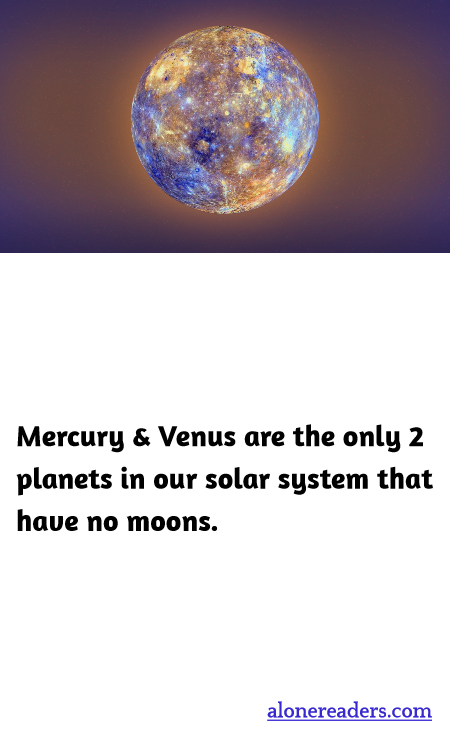
In our solar system, each planet presents a unique set of characteristics, notably in their satellite systems. Mercury and Venus stand out as the only two planets without any natural moons, a feature that raises intriguing questions about the formation and evolution of planets in our solar neighborhood.
Mercury, the closest planet to the Sun, has an extreme environment with surface temperatures that can reach up to 800 degrees Fahrenheit (430 degrees Celsius) during the day and drop to -290 degrees Fahrenheit (-180 degrees Celsius) at night. Given its proximity to the Sun and its small mass, Mercury's gravitational field is weak, making it difficult for the planet to capture or hold onto any material that could form a moon. Additionally, any potential satellite would have to contend with the Sun’s gravitational pull, which could easily destabilize its orbit.
Venus, often called Earth’s twin because of its similar size and composition, also lacks any moons. Scientists speculate that Venus might have had one in the distant past, but intense gravitational interactions with the Sun and other planets, particularly a close encounter with Jupiter, could have stripped away any natural satellites. Furthermore, Venus’s thick atmosphere and its runaway greenhouse effect create surface conditions that are extraordinarily hostile, which could affect satellite stability as well.
The absence of moons around Mercury and Venus may also stem from their positions in the solar system. Both planets formed closer to the Sun where the solar nebula— the cloud of gas and dust left over from the Sun’s formation—was denser and more tumultuous. These conditions could have interfered with the accretion of material necessary to form moons. Moreover, the early solar system was a chaotic place, with collisions between proto-planets and other bodies being common. Such impacts could have prevented moon formation around these planets, or if moons had formed, they might have been destroyed or ejected from orbit.
Understanding why Mercury and Venus have no moons provides insights into planetary formation theories and the dynamic processes that have shaped our solar system. It also highlights the diversity and complexity of planetary systems, influencing how astronomers study planets around other stars. With ongoing and future missions targeting these moonless worlds, scientists hope to uncover more about their histories and their place in the cosmic puzzle of our solar system.
