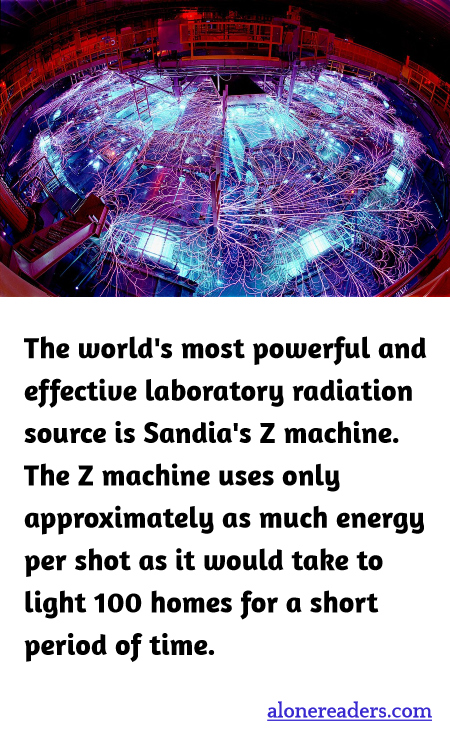
The Z machine, located at Sandia National Laboratories, stands as a testament to the incredible capabilities of modern science and engineering. This remarkable device is renowned for being the most potent laboratory radiation source in the world. Its primary functionality lies in its ability to simulate the extreme conditions found within nuclear explosions and stars, providing crucial data that is not only imperative for nuclear weapons research but also invaluable for advancing our understanding of astrophysics and energy generation.
What makes the Z machine particularly noteworthy is its energy efficiency. Each activation of the machine consumes approximately the same amount of electricity as would be needed to power 100 average homes for a brief period. This efficiency is achieved through an incredibly rapid discharge of electricity, which, for a fleeting moment, generates over 290 terawatts of power and produces temperatures hotter than the sun's surface. This burst of power, albeit short, allows researchers to observe the effects of extreme heat and pressure on materials in a controlled environment.
The Z machine operates by rapidly releasing a powerful burst of electricity into a small amount of wires arrayed in a precise formation. As the current passes through these wires, it vaporizes them, creating a plasma. This plasma is then compressed at an extraordinary speed, resulting in the high temperatures and pressures needed for the experiments. The entire process, from start to finish, takes only a few nanoseconds.
This astounding facility not only provides insights into the fundamental processes of nuclear fusion but also holds potential for developing future clean energy sources. The knowledge gleaned from experiments conducted using the Z machine could lead to advances in nuclear fusion technology, potentially offering a nearly inexhaustible source of energy that produces minimal environmental impact compared to current technologies.
In conclusion, Sandia's Z machine exemplifies the intersection of scientific endeavor and practical efficiency. It continues to be a crucial tool in the fields of energy research and national defense, pushing the boundaries of what is possible in laboratory settings while maintaining a remarkable efficiency in its use of energy. As such, it represents not just a peak of scientific achievement, but also a beacon for future explorations into the potent forces that power our universe.
