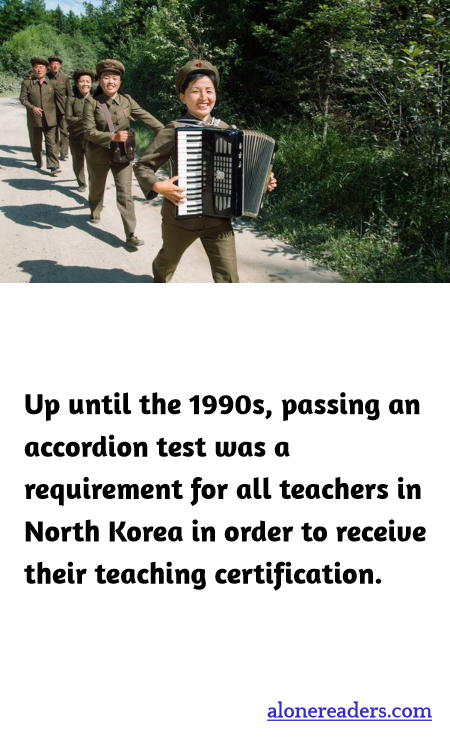
In North Korea, an intriguing facet of the educational and cultural landscape was the mandatory accordion test for aspiring teachers, a practice that persisted until the 1990s. This requirement underscores the unique place that the accordion holds in North Korean society, reflecting both cultural priorities and the government's approach to education and the arts.
The accordion, often referred to as the "people's instrument," gained prominence in North Korea after the Korean War. It was considered an ideal instrument for propagating revolutionary songs and folk music due to its portability and versatility. The regime, led by Kim Il-sung, and later by his son Kim Jong-il, emphasized the importance of music and the arts as vehicles for ideological dissemination and nationalistic pride.
As a result, proficiency in the accordion became a symbolic and practical beacon of loyalty and commitment to the state's ideals. For educators, mastering the accordion was not merely a demonstration of musical skill but also an affirmation of their dedication to the collective spirit and educational philosophy mandated by the government. This requirement was aligned with the larger objective of molding teachers who could not only educate but also indoctrinate students with the values of the ruling Workers' Party.
The process of learning and testing for the accordion involved rigorous training. Teachers had to develop a competent level of skill to pass the test, which included performing various pieces that were significant to North Korean cultural identity and political ideology. The choice of songs often included patriotic melodies that glorified the regime and instilled a sense of national pride and loyalty.
The abolition of the accordion test in the 1990s may be seen as part of a gradual shift in educational focus and priorities. However, the instrument continues to hold a cultural significance in North Korea, featured in celebrations and public performances.
This unique historical anecdote highlights how political ideologies and cultural practices can intersect in unusual and specific ways, influencing even the criteria for educational qualifications. It also serves as a reminder of the powerful role that art and culture can play in shaping and reflecting the values of a society, especially within tightly controlled regimes. While the requirement may seem peculiar from an external viewpoint, within the context of North Korean society, it was a coherent element of the larger ideological and cultural fabric.
