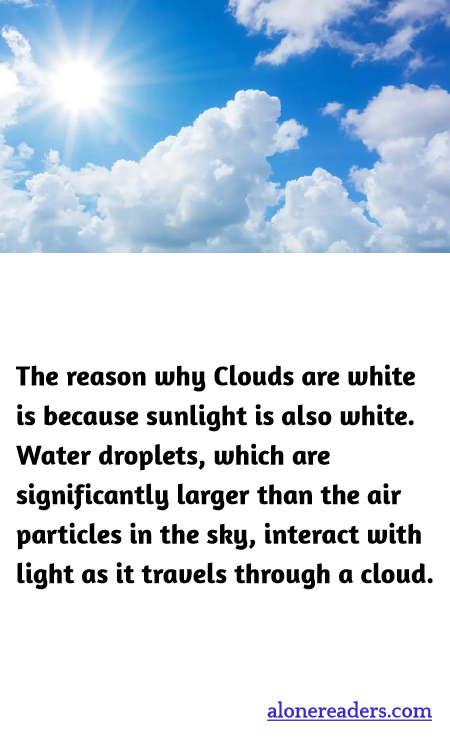
Clouds appear white because of the way sunlight interacts with the tiny water droplets or ice crystals that make up the cloud. Sunlight itself is white, which is actually a mixture of all the colors of the spectrum combined. When this white light from the sun encounters the water droplets in the clouds, something interesting happens.
The droplets are much larger than the wavelengths of light, meaning they scatter all colors almost equally. This process, known as Mie scattering, differs from Rayleigh scattering, which occurs in the clear sky. In Rayleigh scattering, smaller particles, like air molecules, scatter shorter wavelengths of light (blue and violet) more than longer wavelengths (red). This is why we see a blue sky most of the time.
However, in a cloud, because the particles (water droplets or ice crystals) are bigger and more closely spaced, they scatter all colors of light more or less equally. All the colors of light combine to continue appearing as white light, hence clouds typically look white against the backdrop of the blue sky.
Furthermore, the thickness and density of the cloud can affect its color and appearance. Very thick or dense clouds may absorb more light, leading to a darker appearance, sometimes appearing gray, especially if they are heavily loaded with moisture and ready to precipitate as rain or snow. Conversely, thinner clouds can let more sunlight pass through, maintaining their bright white appearance.
Understanding why clouds are white enhances our general comprehension of atmospheric phenomena, enriching our appreciation of the natural world and its intricate interplay of elements. This knowledge is also fundamental in various scientific fields such as meteorology and climatology, where understanding light and atmospheric interactions is crucial for weather prediction and climate study.
