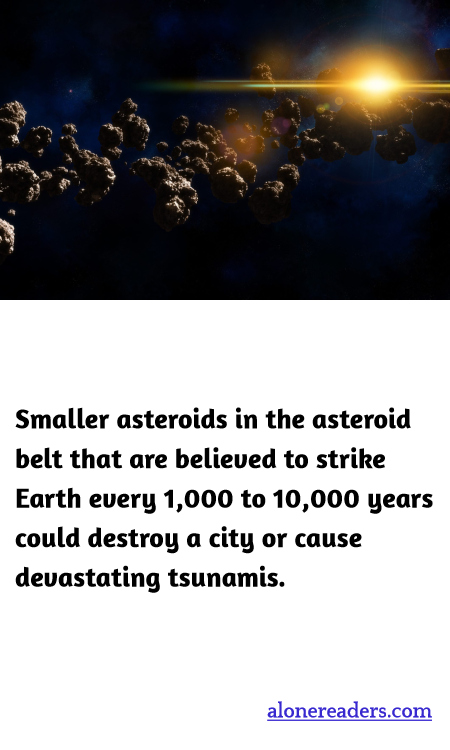
The threat of smaller asteroids in the asteroid belt, those capable of striking Earth every 1,000 to 10,000 years, remains a significant concern due to their potential to unleash catastrophic destruction upon impact. Although less massive than the colossal bodies that contribute to mass extinctions, these relatively diminutive space rocks, often just tens to hundreds of meters in diameter, still harbor enough force to obliterate entire cities or generate massive tsunamis that could lead to widespread devastation.
Despite their smaller size, the kinetic energy released upon their entry into Earth's atmosphere and subsequent impact can be comparable to multiple nuclear bombs detonating simultaneously. For example, the Tunguska event of 1908, caused by an asteroid approximately 50 to 60 meters in diameter, flattened over 2,000 square kilometers of Siberian forest. This event serves as a potent reminder of the destructive power even a relatively small asteroid can possess.
Recognizing these potential threats, global efforts have intensified to monitor and track near-Earth objects (NEOs). Programs such as NASA’s Planetary Defense Coordination Office (PDCO) work in coordination with other international agencies to identify and track the trajectories of these celestial bodies. Advanced technologies enable astronomers to detect smaller asteroids at greater distances than ever before, providing critical data that can be used to predict possible impacts.
In the event that a threatening asteroid is identified, several mitigation strategies could be considered. These strategies include deflection, where the course of the asteroid is altered using a spacecraft or other means to nudge it off a collision path with Earth, and disruption, where the asteroid is broken into smaller, less dangerous pieces.
While the chances of a city-destroying asteroid impact in any given year are low, the potential consequences are so severe that even a remote possibility justifies the investment in detection and mitigation technologies. As our capabilities in space continue to evolve, the goal remains not only to protect human populations but also to maintain the resilience of natural ecosystems against these formidable natural hazards. In doing so, humanity can ensure that it is better prepared to address these and other challenges posed by our dynamic solar system.
