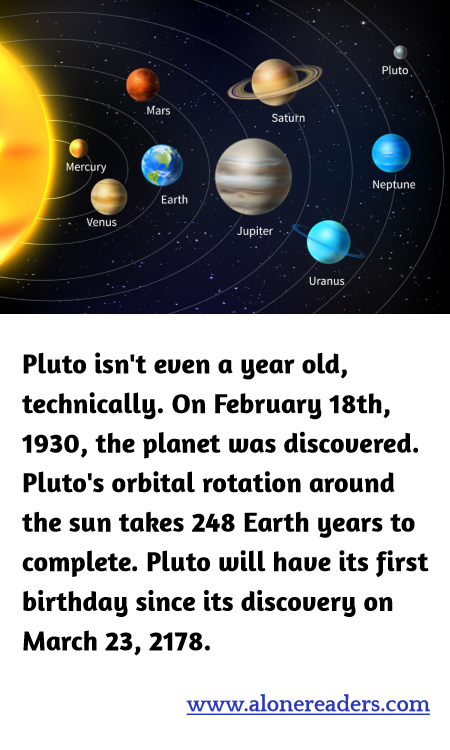
Pluto, long considered the ninth planet of the solar system until its reclassification in 2006 as a dwarf planet, holds an intriguing distinction in terms of "age." Discovered on February 18, 1930, by Clyde Tombaugh at the Lowell Observatory in Arizona, Pluto has yet to complete a single orbit around the Sun since its discovery. Given its distant position in the Kuiper Belt, a region of the solar system beyond Neptune teeming with other small, icy bodies, Pluto’s orbital period is significantly longer than that of the planets closer to the Sun.
Remarkably, it takes Pluto about 248 Earth years to complete one full orbit. This fact means that, measured by its own solar orbits, Pluto is not even one year old. It still has many years to go before it completes its first full journey around the Sun since humans first spotted it through a telescope. Consequently, Pluto will celebrate its first complete orbit since its discovery on March 23, 2178. This slow journey highlights the vast distances and time spans involved in the outer reaches of our solar system.
Most of our understanding of Pluto has been redefined by recent space missions like NASA's New Horizons, which flew by Pluto in July 2015. The close-up images and data provided by New Horizons revealed a more complex and varied world than scientists had anticipated, with ice mountains and a heart-shaped glacier, among other features. These revelations not only expanded human knowledge of the solar system’s dynamics and diversity but also sparked a fresh sense of wonder about these distant celestial objects.
This perspective on Pluto’s orbital duration also offers a way to think about our measurement of time in relation to the cosmos. The idea that the former ninth planet has yet to complete a single year as we understand it underscores the vast scale and the different temporal rhythms present within our solar system. That single incomplete orbit has encompassed the entire modern history of space exploration and much more. Thus, Pluto continues to circle the outer fringes of our solar neighborhood, a chilly, remote outpost on the frontier of human knowledge and imagination.
