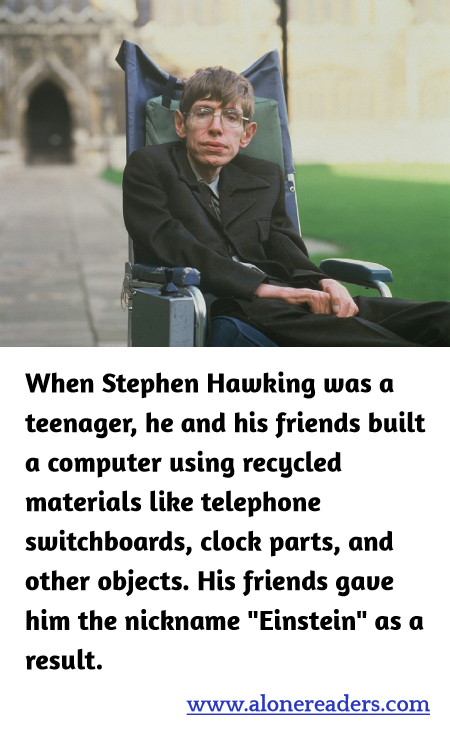
Stephen Hawking's early life was marked not only by academic brilliance but also by a remarkable capacity for innovation. As a teenager, he demonstrated his burgeoning talent for science and technology by building a computer from an eclectic mix of recycled parts—telephone switchboards, old clock components, and various other repurposed items. This project was not merely a hobby but a significant illustration of his understanding of complex concepts and his ability to apply them practically.
This early endeavor foreshadowed the exceptional path Hawking would follow in later years. The computer built by Hawking and his friends was intended to solve basic mathematical equations. The process of assembling this machine involved significant creativity and technical skill, showcasing Hawking’s early knack for problem-solving and engineering. This project, primitive yet ingenious, was indicative of Hawking's potential to think beyond the conventional frameworks and solutions prevalent at the time.
Hawking's peers recognized his unique talents, affectionately dubbing him "Einstein" after the legendary physicist Albert Einstein. This nickname was not only a testament to Hawking's intellectual capabilities but also to his potential to leave a substantial impact on the field of physics. The moniker was prophetic; Hawking would indeed grow to become one of the most influential theoretical physicists since Einstein, making profound contributions to our understanding of black holes, cosmology, and quantum gravity.
Moreover, Hawking's early experiences with building computers from scratch likely played a crucial role in shaping his later exploration of theoretical physics and cosmology. His intuitive grasp of the interplay between technology and scientific inquiry became a defining feature of his academic and professional career, enabling him to use emerging technologies like computer programming to further his groundbreaking research in physics. This blend of theoretical brilliance and practical application is a hallmark of his illustrious career, underscoring the significance of his teenage experiments with technology.
Thus, the seemingly modest project of constructing a computer from discarded parts was a precursor to Stephen Hawking's legacy as a scientist who continuously pushed the boundaries of human knowledge. It exemplifies how youthful curiosity and ingenuity can evolve into a force capable of transforming our understanding of the universe.
