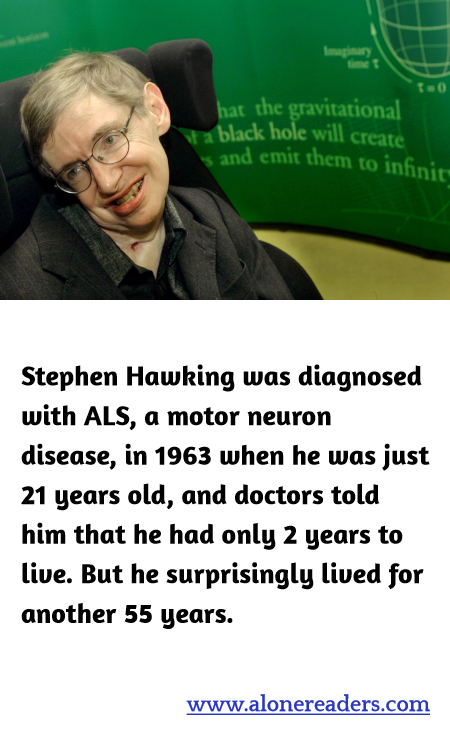
When Stephen Hawking was diagnosed with Amyotrophic Lateral Sclerosis (ALS), also known as Lou Gehrig’s disease, at the age of 21, it seemed that his promising future in theoretical physics would be tragically cut short. Doctors gave him a grim prognosis, estimating he had just two years to live. Yet, Hawking defied these odds spectacularly, continuing his work for over five decades after his diagnosis.
This remarkable longevity was not just a testament to his medical care, but to his indomitable spirit and determination. ALS progressively paralyzes its victims, affecting their ability to move, speak, swallow, and eventually breathe. Despite these challenges, Hawking's intellectual pursuits never waned. As his physical condition deteriorated, and he became almost completely paralyzed, Hawking adapted with the use of a wheelchair and a speech-generating device, which allowed him to communicate through slight movements of his facial muscles.
Hawking’s work in physics and cosmology pushed the boundaries of human knowledge. His insights and theories on black holes and the nature of time have influenced generations of thinkers. Notably, his best-selling book, "A Brief History of Time," brought sophisticated concepts in physics into the realm of general public understanding, showing his remarkable talent for making complex ideas accessible to a broader audience.
Beyond his scientific achievements, Hawking became an emblem of courage and persistence. He made numerous appearances in popular media, from guest spots on television shows like "The Simpsons" and "Star Trek: The Next Generation" to interviews that highlighted his humorous and engaging persona. His public appearances and lectures often left audiences inspired, not just by his intellectual prowess but by his optimistic outlook on life and his infectious sense of humor.
Stephen Hawking’s ability to live a profoundly impactful life, despite the severe limitations imposed by ALS, offers a powerful narrative about human potential and resilience. His legacy is multifaceted, residing not only in his scientific work but also in his ability to inspire and engage with people around the world, demonstrating how determination can transcend even the most daunting of physical limitations.
