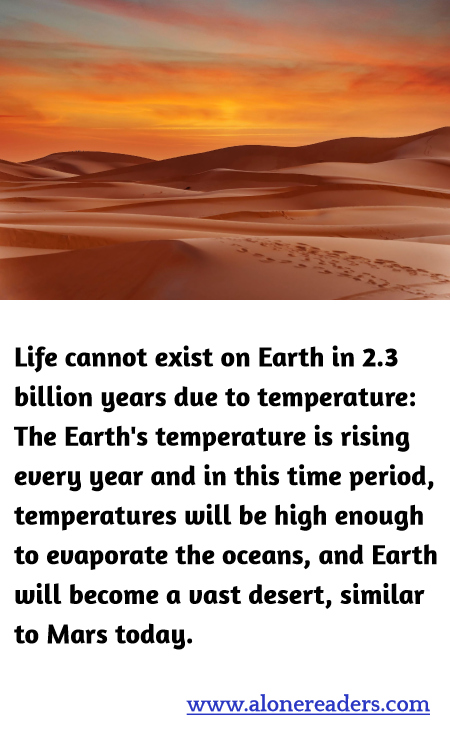
As our planet continues its long journey through time, the prognosis for the distant future stands starkly concerning. Scientists forecast that in approximately 2.3 billion years, Earth's conditions will undergo drastic changes to the point where sustaining life as we know it may no longer be possible. Central to this grim prediction is the continuous rise in Earth's temperatures, a trend that poses a colossal threat to the very fabric of life.
The primary driver behind this temperature increase is attributed to the aging processes of the Sun. As the Sun evolves, it is expected to grow brighter and significantly hotter. This escalation in solar energy output will gradually lead to a rise in our planet's surface temperatures. Such changes are gradual yet irreversible on a geological timescale, affecting every aspect of Earth's climatic systems.
One of the most significant impacts of these elevated temperatures will be on Earth’s oceans, the cradles of life. Predictions indicate that the relentless heat could cause the oceans to evaporate, stripping the planet of its water bodies and launching a catastrophic chain reaction affecting all forms of life. Without oceans to moderate the Earth's climate, temperatures would swing to extremes, making the environment inhospitable.
The resultant scenario would mirror, it is conjectured, the current state of Mars—a barren, desert-like landscape devoid of any bodies of liquid water on the surface. Such a barren Earth would not only be inhospitable to humans but to all life forms, leading to widespread extinction unless life can adapt to extreme conditions or relocate to more habitable environments, perhaps elsewhere in the solar system.
Moreover, this scenario underscores the broader issue of planetary habitability and the fragile balance required to sustain life. It serves as a dramatic reminder of the intrinsic link between celestial processes and terrestrial life. While 2.3 billion years is an almost inconceivable timeframe relative to the human lifespan, understanding these future changes emphasizes the importance of studying planetary and solar mechanics, not just for academic curiosity, but for grasping the long-term outlook for our home planet and its biosphere.
