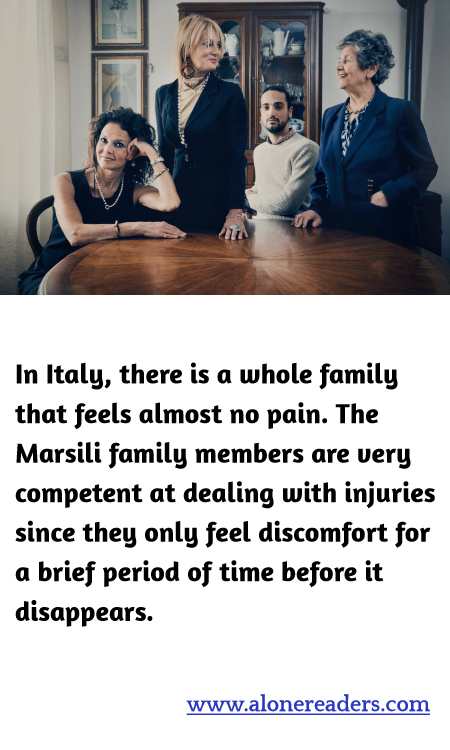
In the scenic landscapes of Italy resides the Marsili family, a unique family known for their extraordinary genetic condition that renders them nearly immune to pain. The phenomenon is so distinctive that the entire family experiences only fleeting moments of discomfort when injuries would normally cause significant or prolonged pain.
This condition has posed both advantages and disadvantages. On one hand, the Marsilis can carry on with daily activities uninhibited by pain that might otherwise incapacitate others. For instance, injuries such as burns, fractures, or cuts which would normally send people rushing to the hospital, cause only a temporary inconvenience to members of the Marsili family. They recover quickly, and the sensation of pain subsides much faster than is typical.
On the other hand, this unusual resistance to pain is also fraught with risks. Pain is a critical warning mechanism that protects the body from serious injuries. It alerts individuals when something is wrong, potentially preventing more serious harm. The Marsilis, lacking such signals, might not immediately notice the severity of an injury or illness. There have been instances where family members have delayed seeking medical attention because they underestimated their injuries, leading to complications that could have been avoided with timely intervention.
The scientific community has shown considerable interest in the Marsili family, studying their genetic makeup to gain insights into the biological pathways of pain. Researchers have identified a mutation in a gene that appears to adjust the way their nervous system responds to pain stimuli. Understanding this unique genetic mutation could have profound implications for developing new pain management therapies, potentially offering relief for chronic pain sufferers without the side effects associated with traditional pain medications.
Such genetic studies can enlighten us about the complexities of human sensations and may pave the way for innovative treatments. By studying extremes of human conditions, such as the nearly pain-free existence of the Marsili family, scientists can potentially enhance the quality of life for many who suffer from debilitating pain conditions. In this way, the peculiar case of the Marsili family extends beyond a medical curiosity, representing hope for future breakthroughs in pain management and therapy.
