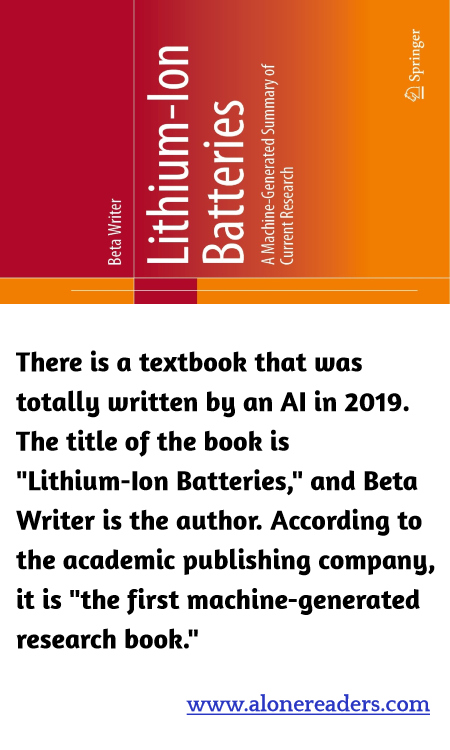
In 2019, a significant milestone was reached in the intersection of artificial intelligence and academic literature with the creation of "Lithium-Ion Batteries: A Machine-Generated Summary of Current Research." Authored entirely by an AI known as Beta Writer, this book was published by Springer Nature, marking it as the first machine-generated research book according to the academic publishing company. This groundbreaking project utilized a state-of-the-art AI that synthesized a vast amount of current research into a cohesive summary.
The AI, developed by researchers from Goethe University in Germany, was fed with a large corpus of literature on the topic of lithium-ion batteries. It then employed natural language processing algorithms to digest and rephrase the most pertinent information into a structured book format. The result was an accessible and informative text that provided a comprehensive overview of the subject, aimed primarily at facilitating further dialogue among the scientific community.
The decision to use AI to author a full-length research book was driven by the need to cope with the rapidly expanding volume of scientific research. With the volume of scholarly articles doubling every three years, the book attempted to demonstrate how AI can assist in managing vast amounts of data and extracting valuable insights. This AI-authored text underscored the potential for such technology to support researchers by summarizing and condensing knowledge, allowing them to grasp developments and findings swiftly.
The publication of "Lithium-Ion Batteries" has not only implications for how academic materials might be authored and consumed in the future but also poses questions about authorship, the role of AI in academic research, and the ways in which the quality and integrity of machine-generated content can be ensured. It opens up a conversation about the integration of AI tools in research activities and their potential to transform traditional academic outputs. As AI continues to advance, its role in assisting and perhaps revolutionizing research and development sectors becomes more significant, suggesting that such AI-driven undertakings will become more common in the production of scientific literature.
