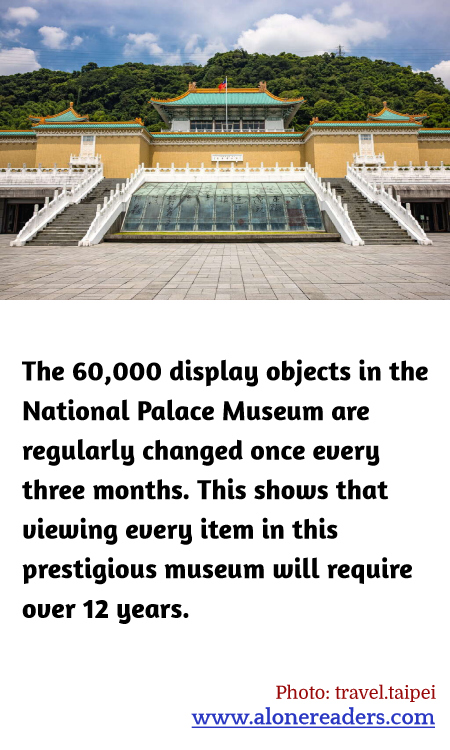
The National Palace Museum, located in Taipei, Taiwan, showcases a vast and illustrious collection of Chinese imperial art, making it one of the most significant museums of Chinese art in the world. Intriguingly, the museum houses approximately 60,000 display objects, each embodying a rich narrative of China's extensive history. However, the viewers are introduced to a dynamic exhibition as these artifacts are regularly rotated once every three months. This systematic rotation is designed to both preserve the sensitive materials of the artifacts from overexposure to light and environmental conditions and to give different pieces a chance to be displayed, providing new experiences for returning visitors.
Given this rotation schedule, the sheer volume of items means that it would take more than 12 years for one to view every piece in the museum's collection, assuming you could visit and review each artifact during each rotation phase. This timeframe highlights not only the vast scale of the collection but also the depth and diversity of Chinese cultural heritage contained within its archives. From ancient bronzes to calligraphy, from ceramics to jade carvings, the exhibitions encompass thousands of years of history.
This rotation and duration needed to view the entire collection underscore the National Palace Museum as a place of ongoing discovery and research, attracting scholars, historians, and art enthusiasts alike. Each visit can offer a completely different perspective depending on the selection and arrangement of artifacts, providing a fresh and insightful experience into the art and history of China. Thus, the museum doesn't just preserve artifacts; it actively engages in a dialogue between the past and the present, making it a living repository of culture and history.
