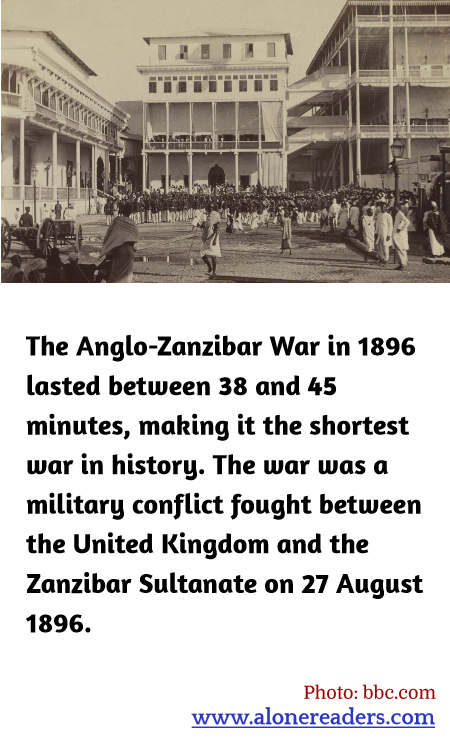
The Anglo-Zanzibar War of 1896 holds the unique distinction of being the shortest war in history, lasting only between 38 and 45 minutes. The conflict erupted on the 27th of August 1896, fundamentally over the succession to the sultanate of Zanzibar. The British Empire, which had established a sphere of influence in the region, was directly involved due to its preference for a pro-British sultan after the sudden death of the pro-British Sultan Hamad bin Thuwaini.
Upon Sultan Hamad's death, Khalid bin Barghash saw an opportunity and took over the palace in Zanzibar Town without British consent. The British, seeking to install a sultan who was more agreeable to their strategic interests in the region, issued an ultimatum to Khalid: step down and leave the palace. Khalid, however, defied this ultimatum and instead fortified his position in the palace and gathered a force of around 2,800 men.
The British response was swift and decisive. They assembled a naval fleet that included five ships and a contingent of marines and sailors. At 9:00 AM, when the ultimatum officially expired, the British forces opened fire on the palace. The bombardment was intense, leveraging the superiority of the British naval firepower. Main targets within the palace complex, including the harem, a significant symbol of Khalid's authority, were heavily shelled.
Within less than an hour, the palace was incapacitated, signaling the defeat of Khalid, who managed to escape to the German consulate and subsequently to German East Africa. This quick and overwhelming show of force resulted in a resolute British victory, with minimal casualties on their side. Zanzibar suffered approximately 500 casualties, both combatants and civilians caught in the crossfire.
Following the bombardment, Hamoud bin Mohammed was installed as sultan, who was more amenable to British interests. He quickly signed a treaty granting extensive judicial and administrative powers to the British in the Sultanate. The war's brevity and decisiveness underscored the dramatic power imbalance between the greatly industrialized British Empire and the smaller Zanzibar Sultanate. It also emphasized the lengths to which the British Empire would go to protect its interests in strategically essential regions during the height of the imperial era. The Anglo-Zanzibar War, although brief, marks a significant episode in the history of European colonialism in East Africa, illustrating the geopolitical dynamics and the imposition of European power on African sovereignties during the late 19th century.
