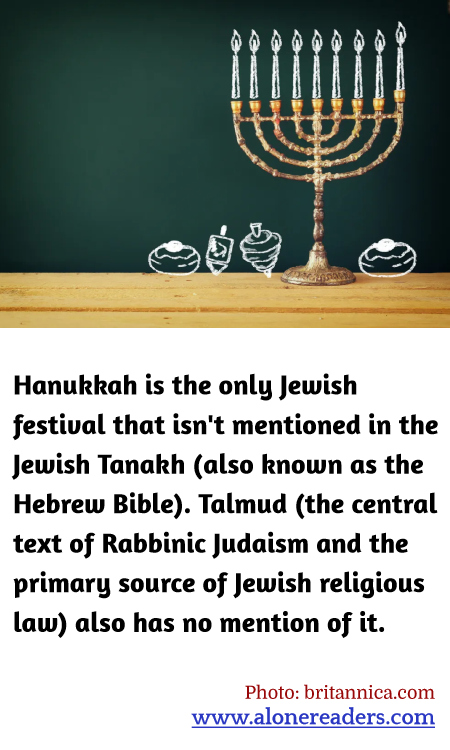
Hanukkah, often referred to as the Festival of Lights, holds a distinctive place among Jewish holidays due to its origins and the way it is observed. Unlike other Jewish festivals such as Passover, Sukkot, and Yom Kippur, which are mentioned in the Jewish Tanakh, Hanukkah does not appear in this canonical collection of texts. This is primarily because the events that inspired Hanukkah occurred after the period described in the Tanakh.
The festival celebrates the rededication of the Second Temple in Jerusalem during the second century BCE, following a successful revolt by the Maccabees against the Seleucid Empire. According to tradition, the miracle of Hanukkah occurred when the Jews, intent on purifying the temple after it had been desecrated, found only a small jar of oil that was only sufficient to keep the temple’s menorah lit for one day. Miraculously, the oil burned for eight days, allowing them enough time to prepare a fresh supply of consecrated oil.
This miracle is the foundation for the eight-day festival of Hanukkah, which involves the lighting of the menorah, with one additional light being lit each evening until all eight are illuminated. Despite its religious significance, the story of Hanukkah and its rituals are largely derived from sources outside the Tanakh, specifically from the texts of the Talmud and the Books of the Maccabees, which, although historically important, are not part of the canonical Hebrew Bible.
In the Talmud, particularly in the tractate of Shabbat, the discussion about Hanukkah offers insights into the rituals and the religious significance of the holiday. The rabbis of the Talmud articulate the laws regarding the lighting of the menorah and the blessings that accompany this act, ensuring that the memory of the ancient miracle and the rededication of the temple are preserved.
Thus, while Hanukkah may not appear in the older canonical texts of Judaism, its celebration is deeply rooted in the historical and spiritual consciousness of the Jewish people. The holiday not only commemorates an important historical event but also promotes themes of resilience, light over darkness, and the miraculous, conveying profound lessons that resonate with many, even beyond the Jewish community.
