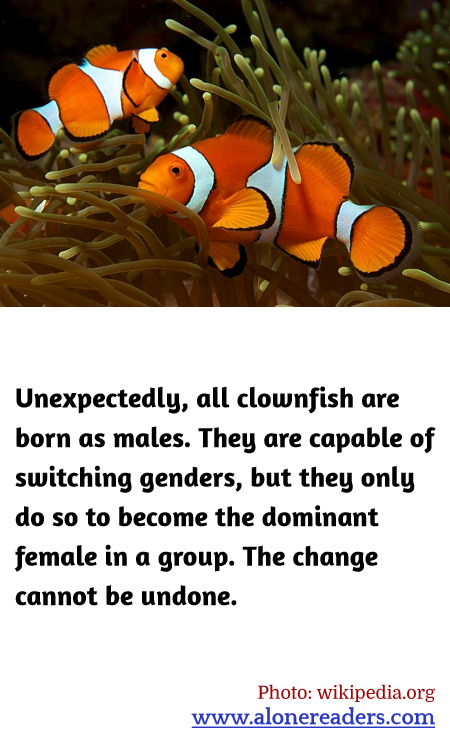
Clownfish, those vibrant inhabitants of warm ocean waters, possess a fascinating biological trait: they are all born male. What is even more intriguing is their ability to undergo a gender switch, a change driven by their social structure and hierarchy. This unique reproductive strategy is known as sequential hermaphroditism, specifically protandry, where an organism starts life as one sex and can change to another.
In the wild, clownfish live in groups that inhabit sea anemones, forming a mutualistic relationship with these stinging sea creatures—each provides protection to the other from potential predators. Typically, a group consists of a breeding pair and several non-breeding fish. The largest and most dominant fish in the group is the female, and the second largest, the breeding male. The rest are smaller, sexually immature males.
The hierarchy within a clownfish group is strict, and when the dominant female dies or is removed, the breeding male then undergoes a sex change and becomes the female. Following this change, one of the remaining males will step up as the new breeding male. This gender transformation involves substantial changes in physiology and behavior and is a one-way process, meaning once they become female, they cannot change back to male.
This sequential hermaphroditism is advantageous in minimizing competition and ensuring reproductive success. Since all clownfish are born as males, each has an equal opportunity to become a breeding male or eventually, the dominant female. By only changing sex in response to the social environment, clownfish can maximize their breeding potential in relation to their specific circumstances, such as the availability of mates and security within the host anemone.
Understanding these fundamentals of clownfish behavior and biology not only underscores the complexity of marine life forms but also highlights the remarkable adaptations organisms can evolve in response to their environmental pressures. The vividly colored clownfish, popularized by the film "Finding Nemo," continues to be a subject of fascination and study, revealing more insights into the intricate dance of nature's evolutionary processes.
