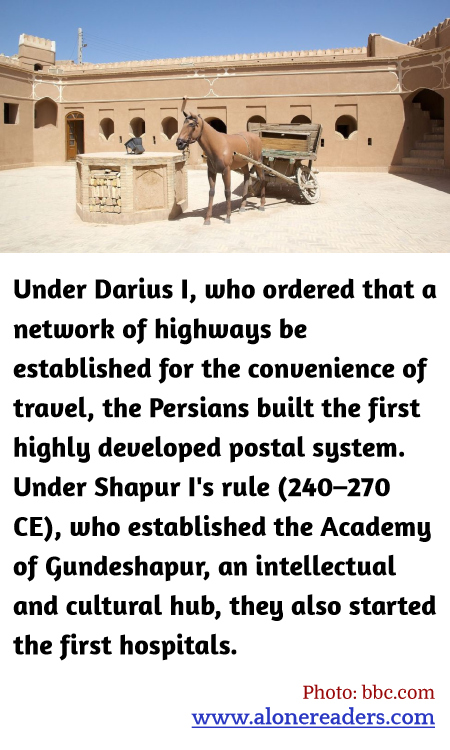
During the reign of Darius I, the Achaemenid Empire saw significant infrastructural advancements, notably the creation of an extensive network of highways that facilitated improved communication and travel throughout the vast empire. This network played a crucial role in reinforcing Darius's control over his territory, which stretched across parts of three continents. With these roads came the establishment of the first highly sophisticated postal system, designed to ensure the swift and reliable exchange of information. Couriers could travel along the Royal Road, for instance, reaching distant locations at unprecedented speeds for the era, thereby enabling efficient governance and timely military response. This postal system not only served governmental needs but also stimulated trade and cultural exchange, contributing to the prosperity and stability of the empire.
Under Shapur I, who ruled several centuries later during the Sassanian period, the Persian Empire cemented its reputation for significant contributions to science and medicine. In his reign spanning 240-270 CE, Shapur I founded the Academy of Gundeshapur. It was not just an intellectual nexus but also the thriving heart of cultural and scientific exchange in the region. Recognized as one of the most important educational institutions of its time, the academy brought together scholars from diverse backgrounds, including many from Indian and Hellenistic traditions, fostering a melting pot of scientific and medical knowledge. Under the auspices of this academy, some of the earliest hospitals were established. These institutions were among the first to be organized for the specific purpose of healing and offered care not only rooted in practical medicine but also influenced by the philosophical and scientific discoveries being made at the academy.
The foundations laid by these important leaders promoted not merely the expansion of territory but also significant advancements in society and culture. Darius’s development of physical infrastructure and Shapur I’s investment in intellectual infrastructure illustrate the dual tracks on which ancient Persian leaders operated to secure the prosperity and wellness of their society. Such initiatives established a legacy of innovation in both tangible and intellectual pursuits that would influence generations to come.
