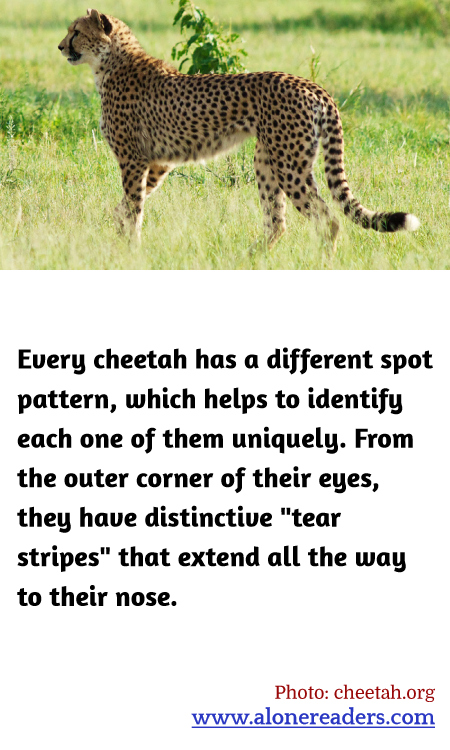
Cheetahs are captivating creatures not only because of their incredible speed, capable of reaching up to 70 miles per hour in short bursts covering distances up to 1,500 feet, but also due to their distinctive coat patterns. Each cheetah has a unique set of spots that covers its fur. These spots range from solid dots to oval shapes and are differently spaced and sized across their bodies. This uniqueness in pattern is akin to the human fingerprint and serves as a means of identification among these majestic animals.
Adding to their distinctive appearance are the notable "tear stripes" that stretch from the corners of their eyes down to the sides of the nose. These markings are thought to have several functions. Primarily, they are believed to protect the eyes from the sun's glare, much like a football player who applies black marks under their eyes during sunny games. This is particularly useful because cheetahs are diurnal, meaning they hunt primarily during the day, with peaks during dawn and dusk when the sun can be particularly harsh. The stripes may also serve as a camouflage mechanism, breaking up the animal's outline among the grass and brush, which helps it stalk close to prey without being detected.
The duality of cheetahs’ coat - the spot patterns and tear stripes - highlights not only their beauty but also their evolutionary adaptations to their environment. The spots help them blend into high grass and scrub environments while stalking prey and the tear stripes might play a critical role in their hunting success, making them one of the most specialized hunters in the animal kingdom. It's this extraordinary blend of speed, stealth, and pattern that conveys the essence of the cheetah's prowess as a top predator in its habitat.
