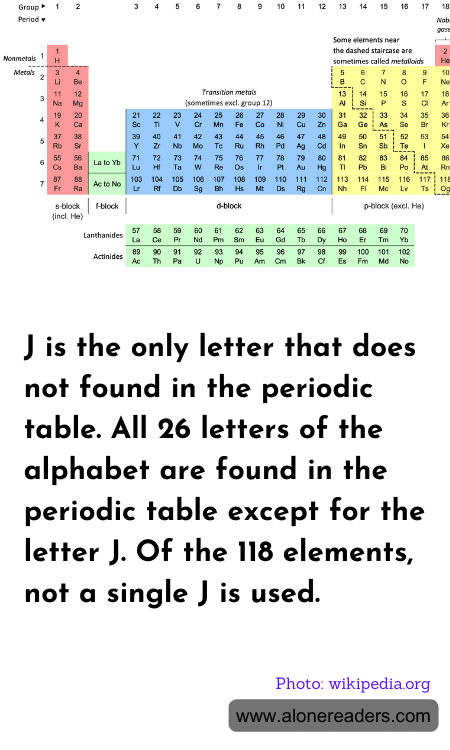
The periodic table, a fundamental cornerstone in the study of chemistry, lists all the known chemical elements in an organized manner based on their atomic numbers, electron configurations, and recurring chemical properties. Each element is represented by a one- or two-letter symbol, which typically derives from its English or Latin name. Interestingly, despite the comprehensive inclusion of numerous letters in these symbols, the letter 'J' is conspicuously absent from the entire periodic table.
This peculiarity stands out because the periodic table encompasses elements with symbols ranging from 'H' for Hydrogen to 'Uuo' for Ununoctium, covering virtually every other letter in the alphabet. The absence of 'J' can be attributed to historical and linguistic factors. In Latin, which has been a traditional language of scholarship, the letter 'J' did not exist; instead, 'I' was used. When the elements were being named and their symbols assigned, many were derived from their Latin names. For instance, Iron is known as 'Ferrum' in Latin, hence its symbol is 'Fe'.
Still, it's intriguing to note that even as new elements have been discovered and named in modern times, the trend has persisted, and the letter 'J' remains unused. This could be due to a continuation of traditional naming conventions or perhaps to avoid confusion with symbols that are already widely recognized and used in scientific literature and education.
The absence of 'J' in the periodic table is a small but fascinating detail that highlights the intersection of linguistics and science. It underscores how historical preferences in language and naming can leave an enduring impact on scientific conventions. While the letter 'J' plays no part in the elemental abbreviations, it serves as a reminder of the rich, complex history behind the development of the fundamental tools we use to understand our world.
