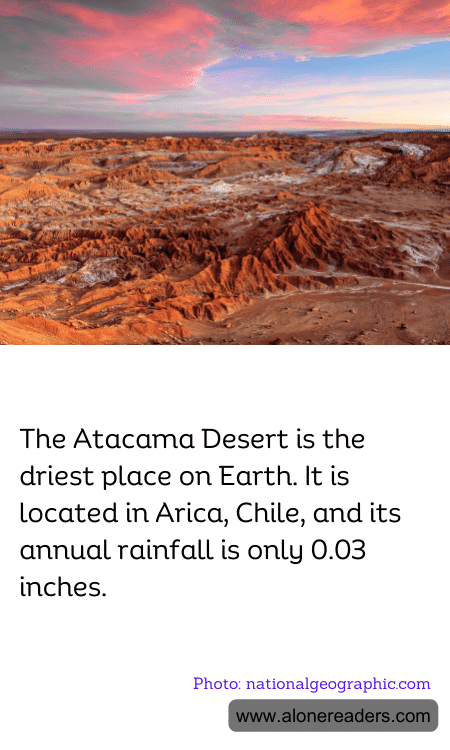
Spanning approximately 1,000 kilometers along the Pacific coast of Chile, the Atacama Desert holds the title of the driest desert on Earth. This remarkable region is not only defined by its stark beauty and extreme conditions but also notably records an average annual rainfall of a meager 0.03 inches (less than 1 mm). The desert stretches into the regions of Arica and Parinacota, drawing the boundary between Chile and Peru, and extending southwards toward the area around Antofagasta.
The extraordinary aridity of the Atacama is the result of a unique combination of geographical and climatic factors. Positioned between two mountain ranges - the Andes to the east and the Chilean Coast Range to the west - the desert is effectively shielded from moisture on both sides. These barriers block the passage of rain-producing weather systems, a phenomenon further intensified by the cold Humboldt Current along the coastal region which cools air and limits cloud formation.
This extreme dryness makes the Atacama a place of scientific and astrobiological interest. Its soil conditions and climate have been compared to those on Mars, making it an ideal site for testing instruments for future Mars missions. Moreover, the clear, dry air and minimal light pollution are perfect for astronomical observations, leading to the installation of some of the world’s most important observatories, such as ALMA (Atacama Large Millimeter/submillimeter Array).
Despite its harsh conditions, the Atacama Desert is not devoid of life. Adapted to extreme aridity, some hardy species thrive here. Unusual bacterial communities can be found in the soil, which are of significant interest to researchers studying the limits of life on Earth. Occasionally, the desert also witnesses a spectacular "blooming desert" phenomenon, where following rare and sporadic rains, its landscape transforms as dormant seeds burgeon into a vibrant display of wildflowers.
Tourism, too, is a significant aspect of the Atacama, attracting adventurers and nature lovers drawn by its otherworldly landscapes, salt flats, hot springs, geysers, and the unique flora and fauna. The desert offers not merely a journey through stark and beautiful terrains but also a profound encounter with resilience and adaptation in one of the world's most extreme environments. This unique combination of scientific intrigue and natural beauty keeps the Atacama a subject of enduring fascination and respect.
