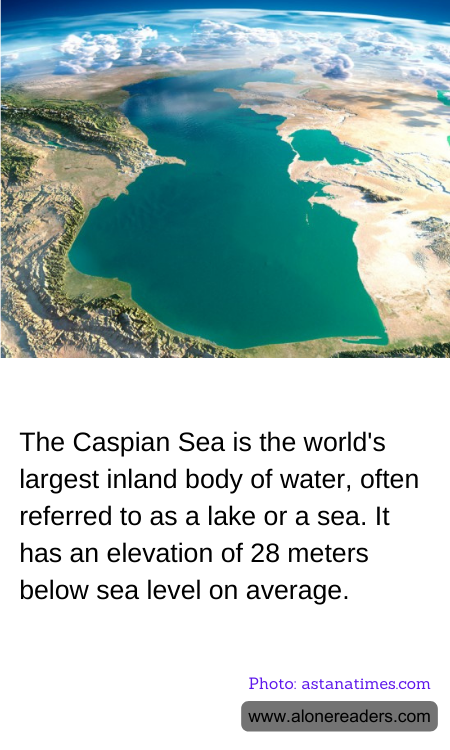
The Caspian Sea, a unique feature of the Earth's geography, straddles the boundary between a lake and a sea, thereby making it a subject of fascination and debate among geographers and environmentalists. This vast body of water, located between Europe and Asia, is the largest inland body of water on the planet, covering about 371,000 square kilometers. Despite being referred to as a sea, the Caspian is technically a lake because it is not connected to the world's oceans and its water is saline, although significantly less so than oceanic water.
The Caspian Sea is bordered by five countries: Russia, Azerbaijan, Iran, Turkmenistan, and Kazakhstan, and each of these has varied economic and ecological interests in its waters. These interests primarily revolve around the abundant natural resources, particularly oil and natural gas beneath its seabed, making the region one of the world's foremost sources of fossil fuels. Over the years, disputes over territorial rights and resource extraction have arisen among these nations, complicating geopolitical relationships in the region.
Ecologically, the Caspian Sea is an essential habitat. It supports a unique biosphere, including numerous endemic species such as the Caspian seal and the famed beluga sturgeon, the latter being the source of much of the world’s caviar. However, the sea faces significant environmental challenges, including pollution from oil drilling and extraction, industrial runoff, and the introduction of invasive species. Additionally, its water level has been subject to dramatic fluctuations historically, influenced by climatic conditions as well as human activities upstream which affect river inflow.
The legal status of the Caspian Sea also presents a complex international legal puzzle. Unlike bodies of water classified strictly as seas or lakes, the Caspian does not fit neatly into existing frameworks of international law, which affects how resources are managed and how its waters and subsoil are utilized. In recent years, the littoral states have made some progress towards resolving these issues, such as the Convention on the Legal Status of the Caspian Sea signed in 2018, which aims to delineate boundaries and resource rights more clearly.
Understanding and managing the Caspian Sea's unique challenges is critical not only for the well-being of the millions of people living around its shores but also for the health of the global environment. As it stands, the Caspian Sea exemplifies the intricate interplay between natural wealth, environmental stewardship, and international cooperation required to manage and protect such a significant natural resource.
