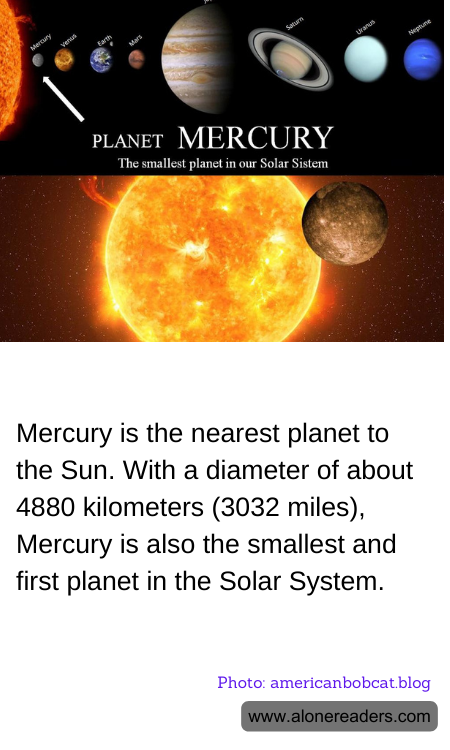
Mercury, often overlooked because of its proximity to the dazzling Sun, holds a unique position as the closest planet to our central star and is intriguing for many reasons. Being the smallest planet in the Solar System, it has a diameter of only about 4880 kilometers, making it even smaller than some of the largest moons in the solar system, such as Ganymede and Titan.
Despite its diminutive size, Mercury exhibits some extreme environmental conditions. Its proximity to the Sun means surface temperatures can soar to a scorching 430 degrees Celsius (800 degrees Fahrenheit) during the day. Conversely, in the absence of a significant atmosphere to trap heat, night-time temperatures on the planet can plummet to minus 180 degrees Celsius (minus 290 degrees Fahrenheit). This dramatic temperature variation is the most extreme of any planet in the Solar System.
Mercury zips around the Sun every 88 Earth days, traveling through space at a speed about 1.5 times faster than Earth. However, its rotation is quite slow; it rotates on its axis only once approximately every 59 Earth days. This results in long days and nights on Mercury—a single day-night cycle on Mercury lasts about 176 Earth days.
The surface of Mercury is heavily cratered, bearing witness to numerous impacts over billions of years. Notably, it is home to the Caloris Basin, one of the largest impact craters in the Solar System, which is about 1,550 kilometers in diameter. The surface also features vast plains, steep cliffs, and irregular depressions.
Mercury’s internal structure is dominated by a large metallic core, which makes up about 85% of the planet's radius. This core is surrounded by a relatively thin mantle and crust. The existence of such a large core suggests that Mercury was once much larger, but lost much of its outer shell to a massive impact or a series of impacts early in its history.
Interestingly, despite the harsh conditions that characterize the planet, there are indications that Mercury holds water ice and possibly organic molecules in its permanently shadowed polar craters. These craters never receive sunlight and are thus cold traps that preserve ice, providing crucial hints about the processes that might impact ice distribution across the Solar System.
Understanding Mercury is crucial not just for comprehending the formation and development of planets in our solar system, but also for preparing for future explorations. Missions like NASA’s MESSENGER spacecraft, which orbited Mercury between 2011 and 2015, and the upcoming BepiColombo mission, a joint project of the European Space Agency and the Japanese Aerospace Exploration Agency, are vital for uncovering the mysteries of this small, swift planet. Each mission brings us closer to a more comprehensive understanding of these alien landscapes, providing invaluable insights into our cosmic neighborhood.
