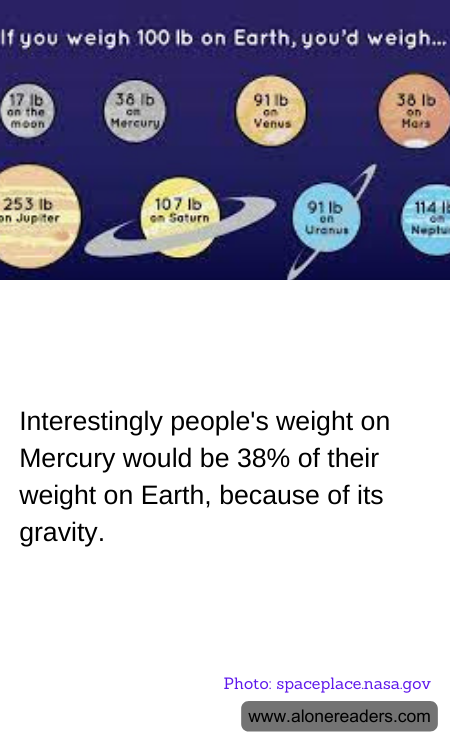
When considering space travel or planetary colonization, understanding the gravity of different celestial bodies becomes fascinating and crucial for preparation. The weight of an object or person can drastically vary from one planet to another. On Mercury, for example, a person would weigh only 38% of their Earth weight because Mercury's gravitational pull is much weaker than Earth’s.
Mercury, the smallest planet in our solar system and closest to the Sun, has a gravitational force that is just about 38% as strong as Earth's. This is due to its smaller mass and size compared to Earth. The formula to calculate weight in different celestial environments involves multiplying the object’s Earth weight by the gravitational force relative to Earth. So, if you weigh 100 pounds on Earth, you would weigh only 38 pounds on Mercury.
The significant reduction in weight on Mercury has profound implications. From an astronaut's mobility to the architecture of bases and the way tools and equipment are designed, everything requires recalibration. For instance, walking and other simple movements would not be the same as on Earth due to the reduced gravity allowing for higher, longer jumps but also posing challenges with balance and muscle use.
Furthermore, the difference in gravity affects the atmosphere and environment. Mercury has barely any atmosphere because its weak gravity cannot retain an atmosphere as thick as Earth’s. This results in extreme surface conditions, such as very high temperatures, making it a challenging environment for potential colonization or extended human visits.
For future interplanetary travelers, adjusting to such diverse gravitational fields will be integral to their training. From maintaining physical health to ensuring the safety and functionality of equipment, understanding and preparing for these differences in weight and gravity will be essential for successful missions and perhaps, long-term habitation. The exploration of Mercury and other planets thus opens up new realms in space science, compelling us to rethink what we know about physics, biology, and the potential for life beyond Earth.
