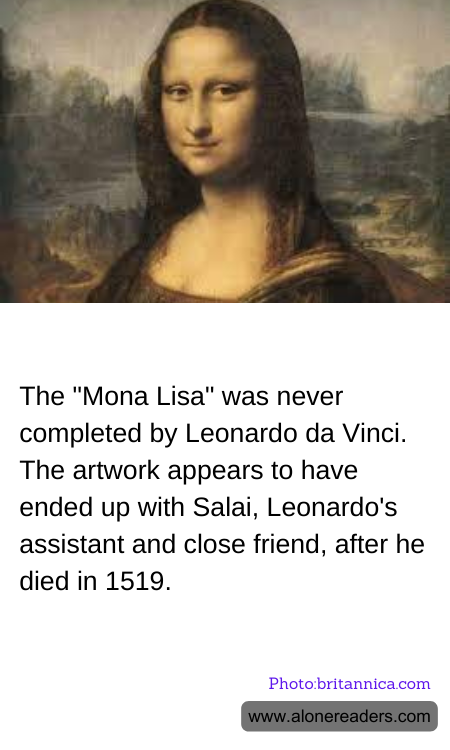
The "Mona Lisa," arguably the most famous painting in the world, is often considered a masterpiece of Renaissance art. Yet, there are intriguing details about its completion and its journey after Leonardo da Vinci’s death that continue to fascinate historians and art lovers alike. Despite popular belief, Leonardo never officially completed the "Mona Lisa." Throughout his life, Leonardo was known for his perfectionism and frequently left his artworks unfinished, and the "Mona Lisa" was no exception. He continued to tweak and adjust the painting until his death in 1519, constantly striving to perfect its details.
Upon Leonardo’s death, the painting was inherited by his assistant and perhaps his most beloved student, Salai. Salai had been a close companion and collaborator of Leonardo for over two decades, and his relationship with the master was complex and deeply personal. Salai's acquisition of the "Mona Lisa" underscores his significant role in Leonardo's life and studio. It is believed that Leonardo’s attachment to the painting, combined with Salai's proximity to his creative processes, led to this bequest, although detailed records from that time are scarce.
The fact that Leonardo continued working on the "Mona Lisa" for many years, unable to ever consider it complete, adds a layer of mystique to the painting’s history. This element of perpetual incompletion might be seen as a reflection of Leonardo’s quest for knowledge and his relentless pursuit of artistic perfection, characteristics that defined his entire life and career.
After Salai came into possession of the painting, the "Mona Lisa" remained relatively obscure until it was acquired by King Francis I of France, a known patron of the arts and an admirer of Leonardo. This marked the beginning of the painting’s ascendancy to global recognition. It was eventually placed in the Louvre Museum in Paris, where it has resided since, capturing the imaginations of millions of visitors each year.
In sum, the journey of the "Mona Lisa," from an incomplete portrait in the hands of an extraordinary polymath to a celebrated treasure in one of the world’s most famous museums, encapsulates a fascinating chapter in the history of art. That Leonardo da Vinci never considered it finished only heightens the allure and enduring appeal of the painting, illustrating the timeless nature of true artistic endeavor.
