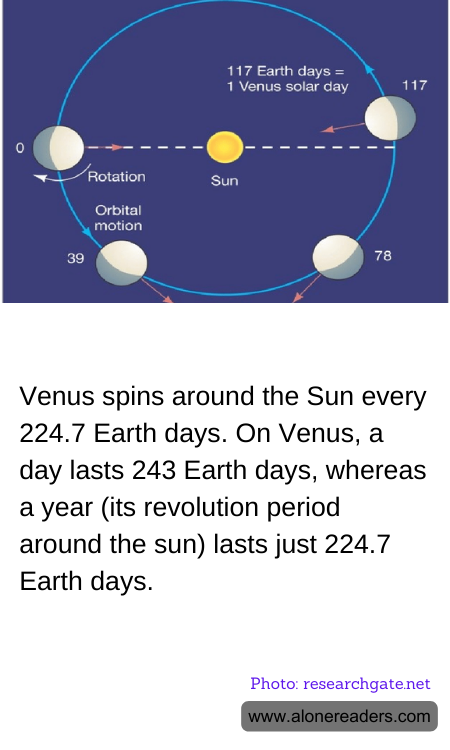
Venus, the second planet from the sun, holds the title for having the longest day in relation to its year in our solar system. Quite unusually, a single day on Venus lasts longer than its entire year. To understand this, one needs to differentiate between a solar day and the planet's orbital period around the sun. A solar day on Venus, which is the time taken for the sun to return to the same position in the sky, is about 243 Earth days. Conversely, Venus completes its orbit around the sun in just 224.7 Earth days, making its year shorter than its day.
This peculiar phenomenon is due to Venus’s slow rotation on its axis, combined with its direction of spin. Interestingly, Venus spins on its axis in a direction opposite to most planets in the solar system, a trait known as retrograde rotation. This means that if viewed from above, Venus rotates clockwise while most other planets rotate counterclockwise. This retrograde motion contributes to the length of the Venusian day.
The origin of Venus’s slow and retrograde rotation is still a topic of scientific inquiry. One theory suggests that gravitational interactions with the sun and other planets, as well as the effects of solar tides, might have slowed down and altered its rotational direction. Another hypothesis posits that a massive collision with a celestial body early in its history could have caused the planet's slow and reverse spin.
Despite its hostile surface conditions, with scorching temperatures and a thick, toxic atmosphere, Venus's unusual rotational characteristics fascinate scientists and reinforce the diversity found within our cosmic neighborhood. Studying these peculiarities provides crucial insights into planetary formation and dynamics throughout the solar system.
