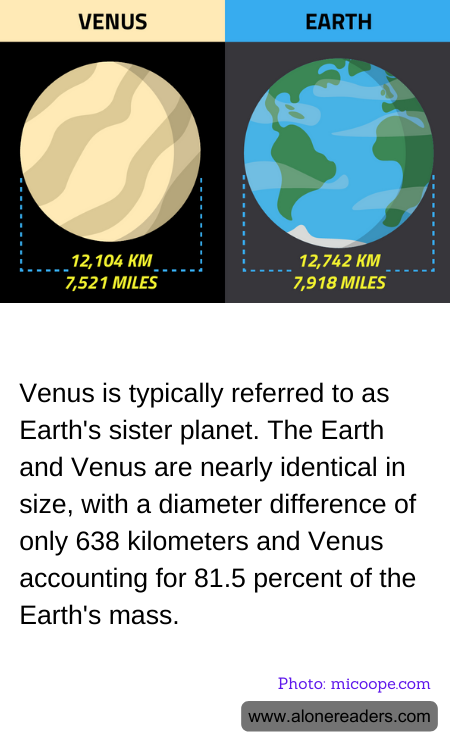
Venus, often dubbed Earth's sister planet, shares several striking similarities with our home, most notably in size and mass. This proximity in physical dimensions has fascinated scientists and astronomers for centuries. Only 638 kilometers smaller in diameter than Earth, Venus presents a physical profile that is remarkably close to that of Earth, accounting for 81.5 percent of Earth's total mass.
Despite these similarities, the environmental conditions on Venus are drastically different from Earth's. Venus has a dense, toxic atmosphere composed mainly of carbon dioxide, with clouds of sulfuric acid, making its surface pressure 92 times that of Earth and its temperatures reach a scorching 464 degrees Celsius (867 degrees Fahrenheit). This extreme heat is primarily due to a runaway greenhouse effect that makes the Venusian environment not only inhospitable but also drastically different from the Earth’s climate.
The exploration of Venus has also provided insights into the possibilities of climate extremities on Earth. Understanding Venus's atmosphere and geological activity helps scientists predict and model Earth's climatic future and the potential consequences of unchecked greenhouse gases. Space missions to Venus, such as those conducted by the Soviet Union’s Venera program and NASA’s Magellan spacecraft, have been pivotal in gathering vital data about Venusian topography and atmospheric conditions.
Moreover, the study of Venus contributes to the broader search for exoplanets and the possibility of life in conditions different from those on Earth. By comparing Earth's environment to that of Venus, scientists hope to refine their criteria for habitability and better understand how life-sustaining planets can exist under varying cosmic circumstances.
Hence, while Venus and Earth share a sibling-like resemblance in mass and structure, their environmental divergences provide a rich field of study that not only teaches us about the extremes of planetary climates but also expands our understanding of the potential for life across the universe. This stark contrast between Venus and Earth underscores the fine balance of conditions necessary for life and prompts a deeper appreciation and understanding of our own planet’s environment.
