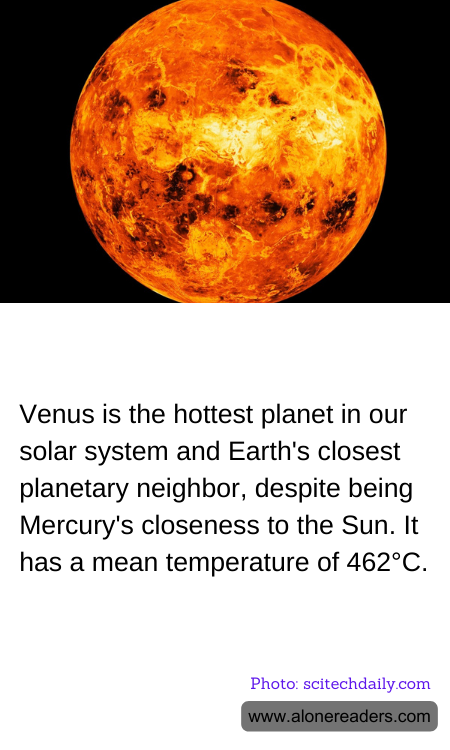
Venus, often called Earth's "sister planet" due to similarities in size, composition, and proximity, starkly contrasts with Earth in terms of environmental conditions. This planet, intriguingly, holds the title for the hottest in our solar system, a fact that surprises many considering it is not the closest planet to the Sun — that distinction belongs to Mercury. However, Venus's thick, toxic atmosphere is primarily composed of carbon dioxide, with clouds of sulfuric acid, making it an extreme example of the greenhouse effect.
The surface temperature of Venus averages a scorching 462°C (864°F), which is hot enough to melt lead and significantly warmer than Mercury, which can have temperatures ranging from -180°C to 450°C. This intense heat is attributed to Venus's dense atmosphere, which is about 90 times thicker than that of Earth and traps heat effectively. The composition of Venus's atmosphere allows it to absorb large quantities of solar radiation and prevent any heat escape back into space.
The environmental conditions on Venus are not only defined by its high temperatures but also by its crushing atmospheric pressure, which is equivalent to being 900 meters deep in the Earth's oceans. This, combined with the extreme heat, creates a surface environment that is utterly inhospitable to any form of life as we know it. Surface conditions have been described based on observations from Soviet Venera probes in the 1970s and 1980s, which managed to transmit data and images from the surface before succumbing to the harsh conditions.
Moreover, Venus rotates very slowly on its axis, taking about 243 Earth days to complete one rotation, which is longer than its 225-day orbit around the Sun. This slow rotation contributes to its extreme weather patterns, including wind speeds that can exceed hundreds of kilometers per hour in the upper atmosphere. Despite these winds, the surface winds are slower due to the high pressure.
Venus’s hostile attributes make it a fascinating subject for scientific study, providing insights into planetary atmospheres, climate change, and the dynamics of rocky planets. The understanding of Venus’s climate and atmospheric phenomena also has implications for studying Earth's own environmental changes. Current and future missions to Venus aim to delve deeper into understanding its geology, atmosphere, and the possibility of it having once harbored water and, potentially, life. With advancements in technology and mission planning, our neighboring planet continues to be an intriguing celestial subject in our quest to understand the cosmos better.
