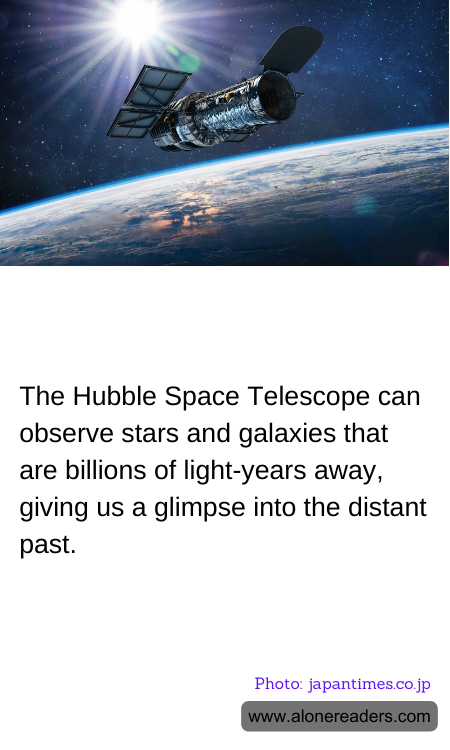
The Hubble Space Telescope, launched into orbit in 1990, stands as one of humanity's most significant observatories. Unlike telescopes based on the Earth's surface, Hubble orbits outside the distortion of Earth's atmosphere, which allows it to capture much clearer, more detailed images of the universe. This unique vantage point has enabled Hubble to peer back into the very distant past, observing celestial bodies that are billions of light-years away.
In essence, looking at objects that are billions of light-years away means observing them as they were billions of years ago, because the light from those objects has taken that long to travel to us. This incredible function of the Hubble Space Telescope essentially allows scientists to look back in time, offering insights into the early universe moments after the Big Bang.
This capacity has led to numerous profound discoveries. For example, Hubble has helped determine the rate of expansion of the universe, observed the properties and atmospheres of planets orbiting other stars, and unveiled the presence of black holes at the centers of galaxies. Each image captured by Hubble is not just a glimpse of the stars and galaxies but a historical record of their evolution over billions of years.
Hubble’s observations have also been critical in studying phenomena such as quasars, supernovae, and gamma-ray bursts, providing data that challenge existing theories and lead to newer, more refined understandings of the cosmos. Moreover, by looking at very faint and distant galaxies, Hubble has significantly contributed to our knowledge about the shape, content, and fate of the universe.
As of its last service mission in 2009, Hubble has continued to function, continually pushing the boundaries of our cosmic knowledge. Its successor, the James Webb Space Telescope, aims to delve even deeper into the mysteries of the universe, further expanding on the groundbreaking work done by Hubble. Thus, even as technology progresses, the legacy of the Hubble Space Telescope as a portal into our universe’s distant past will undoubtedly remain a cornerstone in the field of astronomy.
