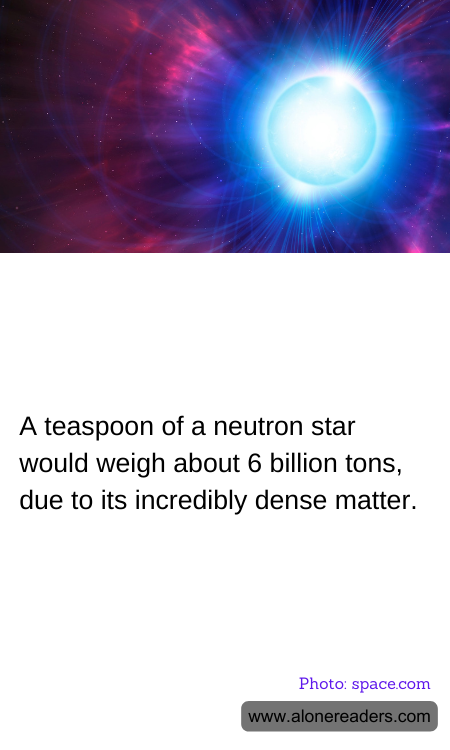
Neutron stars are some of the most fascinating and extreme objects in the universe. They are the remnants of massive stars that have undergone a supernova explosion. What is left behind is a superdense core, primarily composed of neutrons, which gives the neutron star its name. These stars are incredibly compact, with diameters about 20 kilometers across, yet they contain more mass than the Sun. This extreme density leads to some staggering characteristics, most notably their incredible gravitational pull and the bizarre fact that a teaspoon of material from a neutron star would weigh about 6 billion tons.
This extreme weight arises from the density of neutron stars which is almost beyond comprehension. They pack their mass so tightly that their neutrons are squeezed together to the point where they eliminate virtually all empty space between them. To visualize just how dense neutron stars are, consider this: if you could compress Earth down to the same density as a neutron star, it would measure only around 200 meters across.
The implications of such density are profound both in terms of gravitational force and the quantum mechanics at play. The gravity on the surface of neutron stars is the strongest known in the universe among stably existing objects. If you were to stand on the surface of a neutron star (ignoring the impossible conditions), you would experience gravity billions of times stronger than that on Earth. This immense gravity affects the behavior of light and matter in the vicinity of the star. It can bend light from behind the star, and any nearby objects would be pulled violently towards it.
However, the star’s density also results in its surface gravity being so strong that it significantly warps the fabric of space-time, as described by Einstein's general theory of relativity. Neutron stars are also known for their rapid rotation rates and the emission of beams of electromagnetic radiation, which makes them observable on Earth as pulsars. These pulsars emit beams of radio waves and other electromagnetic radiation along their magnetic poles, which sweep across the cosmos as the star rotates, often visible from light-years away.
In essence, the extraordinary fact that a teaspoon from a neutron star would weigh about 6 billion tons encapsulates not just the extreme nature of these cosmic bodies, but also the incredible physics at play in the observable universe. The study of these dense remnants offers insights into the laws of physics under the most extreme conditions, thus challenging our understanding of the fabric of the universe itself.
