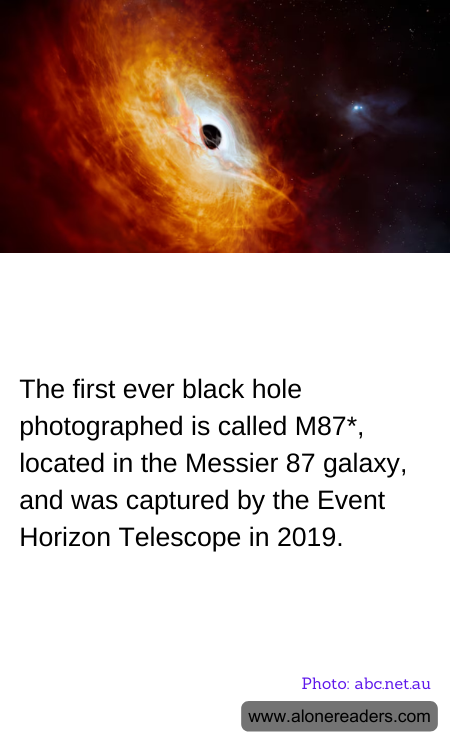
In a monumental achievement in the field of astrophysics, the first ever image of a black hole was unveiled to the public on April 10, 2019. This historic black hole, designated M87*, resides in the heart of the massive galaxy Messier 87, situated some 55 million light-years from Earth. The black hole itself is a colossus, boasting a mass that is 6.5 billion times that of our sun, making it one of the largest known black holes.
The remarkable image was captured by the Event Horizon Telescope (EHT), a planet-scale array of eight ground-based radio telescopes forged through international collaboration. Designed to capture images of black holes, the EHT focuses on two supermassive black holes, with M87* being one. The other is Sagittarius A*, located at the center of our Milky Way galaxy.
The image of M87* appears as a blurry, fiery doughnut-shaped object, showing a bright ring formed as light bends under the intense gravity around a black hole that is 25 billion miles across. This visual evidence of the black hole’s shadow is consistent with theoretical predictions about black holes. The ring is brighter on one side because the black hole is rotating, dragging space-time around with it in a phenomenon known as frame-dragging.
This groundbreaking image was the result of years of collaboration among scientists from around the world and stands as a testament to human ingenuity and the power of collective scientific efforts. It not only confirms the existence of black holes, predicted by Einstein's theory of general relativity, but also provides valuable insights into the properties of black holes, such as their enormous gravitational force capable of pulling in light.
Further implications of this discovery are immense for the field of physics, as it opens new avenues for understanding the most mysterious objects in the universe. The image serves as a key to unlocking answers about the laws governing the cosmos, the dynamic processes occurring in a galaxy's dense central hub, the ways supermassive black holes interact with their surroundings, and more. It’s a pivotal step forward in our quest to comprehend the vast, intricate nature of the universe we inhabit.
