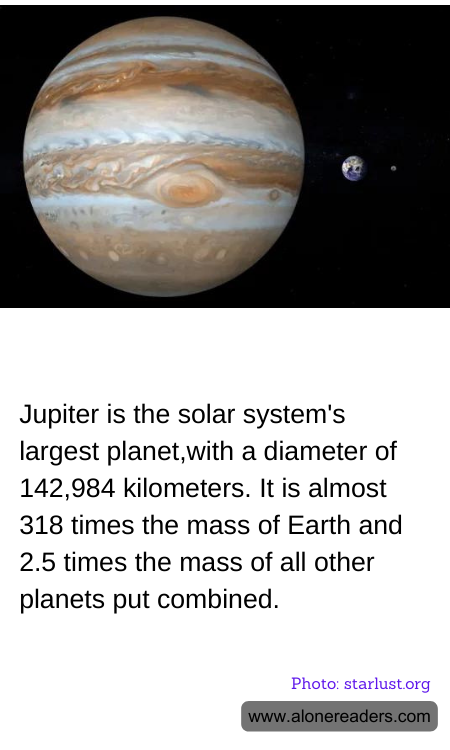
Jupiter, a gas giant, is not only the largest planet in our solar system but also one of the most fascinating. Spanning a diameter of about 142,984 kilometers, it stands as a colossal entity in space, almost 318 times more massive than Earth and holding 2.5 times the mass of all the other planets combined. This massive size allows Jupiter to exert a strong gravitational pull, dominating a large region of space and influencing the orbits of other bodies within its vicinity.
The composition of Jupiter is primarily hydrogen and helium, similar to the Sun, which underscores its nickname as a "failed star." If Jupiter had been roughly 80 times more massive, it might have had enough mass to ignite nuclear fusion and become a star itself. Instead, it remains the largest planet, with a complex and layered atmosphere characterized by bands of clouds and storms, the most famous being the Great Red Spot. This giant storm, larger than Earth itself, has been raging for hundreds of years, offering a glimpse into the dynamic and violent atmosphere of Jupiter.
Jupiter’s importance extends beyond its physical characteristics. It plays a crucial protective role in our solar system. Its strong gravitational pull helps to steer comets and asteroids away from Earth, acting as a kind of cosmic shield. This function of Jupiter could have been crucial in allowing life to develop on Earth by significantly reducing the number of potentially catastrophic impacts.
The planet also hosts a large family of moons, with close to 80 known satellites. The four largest—Io, Europa, Ganymede, and Callisto, known as the Galilean moons—were first observed by Galileo Galilei in 1610. Each of these moons is a fascinating world in its own right, from Io’s volcanic surface to Europa’s subsurface ocean which might contain more water than all of Earth’s oceans combined and might even harbor life.
Jupiter’s immense presence and its moons make it a significant point of interest for scientific study. Missions such as the Juno spacecraft, which has been orbiting Jupiter since July 4, 2016, provide valuable data about the planet’s atmosphere, magnetic field, and structure. Such missions aim to unlock more secrets of Jupiter, potentially shedding light on the early solar system's formation and evolution and contributing to our understanding of giant planet systems around other stars.
