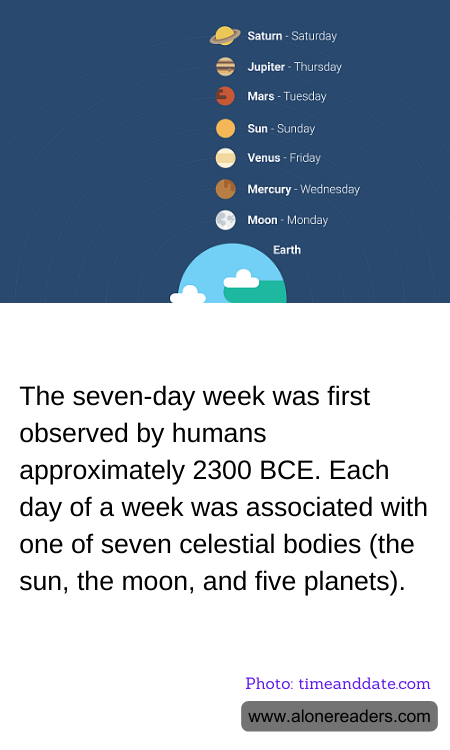
The concept of a seven-day week dates back to around 2300 BCE, emerging as a significant time-keeping structure in various cultures, notably among the ancient Babylonians. Their astrological beliefs played a crucial role in shaping the week, with each day correlating to a celestial body that they could observe with the naked eye. These included the Sun, the Moon, Mars, Mercury, Jupiter, Venus, and Saturn. This system was not only a reflection of their astronomical knowledge but also their religious and mythological worldviews.
Each day was dedicated to one of these celestial bodies, and this tradition had profound implications on later cultures, including the Romans who inherited and adapted this system. The Romans named the days of the week after their gods, which were associated with these celestial bodies. For example, Sunday was dedicated to Sol (the Sun), Monday to Luna (the Moon), Tuesday to Mars, Wednesday to Mercury, Thursday to Jupiter, Friday to Venus, and Saturday to Saturn. These names and associations are preserved in many modern languages today, illustrating the lasting influence of this ancient system.
The adoption of a seven-day week spread across different civilizations over the centuries, with each culture imparting its nuances to the concept. The Jews, for instance, crystallized the seven-day cycle in their calendar, attributing it with spiritual significance due to the Biblical creation narrative which aligns with a week culminating in a day of rest, the Sabbath. Christians and Muslims later adopted variations of this weekly cycle as well, aligning religious observances and communal practices with specific days.
The widespread and enduring acceptance of the seven-day week across disparate cultures and epochs is a testament to its practicality and the human desire to seek patterns and meaning in the cosmos. Ultimately, the seven-day week is more than just a method to segment time; it is a cultural construct that offers insights into how ancient people interacted with the universe and sought to understand their place within it. This system has not only organized our time but has also influenced social, religious, and cultural practices across millennia, highlighting its significance as one of humanity's enduring inventions.
