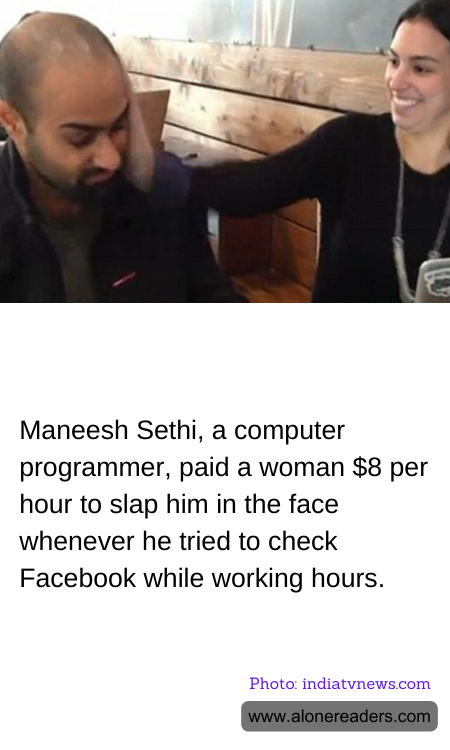
In an unconventional approach to boosting productivity, Maneesh Sethi, a computer programmer, devised a unique method to keep himself focused while working. Sethi hired a woman to slap him in the face every time he attempted to check Facebook during his work hours. This radical approach stemmed from his realization of the massive chunk of time that social media was chewing out of his workday. According to Sethi, he was losing as much as 19 hours a week to distractions, predominantly social media platforms like Facebook.
Sethi’s method, as radical as it may seem, is rooted in behavioral psychology. By associating an immediate negative stimulus—being slapped—with the act of checking Facebook, he aimed to condition himself to avoid the distraction. This technique, though extreme, is based on the principles of conditioning theory where behaviors can be changed through associations with positive or negative outcomes. It’s an aggressive form of what psychologists call 'aversive conditioning'.
The woman Sethi hired was paid $8 an hour for her services, and her sole job was to monitor his computer screen. Whenever she noticed him switching tabs to log into Facebook, she would carry out the agreed-upon slap. The decision to hire someone specifically for this task underscores the challenges individuals face with self-regulation in the digital age, where distractions are just a click away and can significantly detract from productivity.
Sethi's experiment garnered mixed reactions from the public and experts. Some hailed it as a clever, if unorthodox, hack to combat the perennial problem of procrastination and digital distraction. Others raised eyebrows at the extremity of the method and its implications on self-control methodologies. Regardless of the diverse opinions, Sethi reported a significant improvement in his productivity levels and a drastic reduction in his Facebook usage during work hours.
While not everyone might be inclined to employ such drastic measures to keep themselves from social media during work, this instance highlights the lengths to which some are willing to go to enhance focus and efficiency. It opens up a broader discussion about the balance between technology and productivity, and the innovative, sometimes extreme, strategies that individuals create to maintain this balance in the era of constant digital notifications and distractions. This approach by Sethi might be an outlier, but it underlines a very real and common struggle among professionals to stay focused in an increasingly interruptive digital world.
