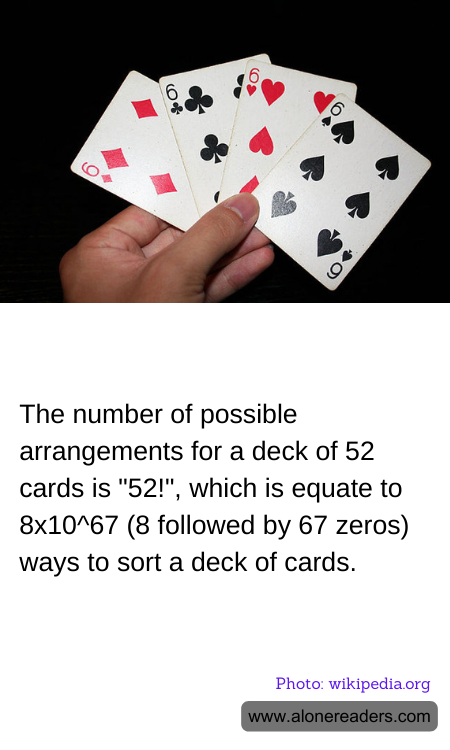
The sheer magnitude of possible combinations in a standard deck of 52 cards is a concept that boggles the mind. When we calculate the number of unique ways to arrange these cards, the result is a factorial of 52 (denoted as 52!). This means you multiply 52 by every number below it down to 1. The end result is stupefying: approximately 8 x 10^67, a number so vast it surpasses common understanding.
To put this astronomical figure into perspective, if every star in our Milky Way galaxy had a trillion planets, each with a trillion people living on them, and each of these people had a trillion decks of cards and somehow could shuffle them a thousand times per second, and they had been doing so since the Big Bang, they would not even have begun to cover all the possible arrangements of one single deck.
This immense number reflects the complexity and unpredictability inherent in seemingly simple systems. It explains why, every time you shuffle a deck, you are almost certainly holding an arrangement of cards that has never before existed in the history of the universe. This level of unpredictability makes card games fascinating and ensures that no two games are ever the same.
Moreover, this fact is more than just a curiosity—it's used in cryptography for creating extremely strong passwords and security measures. The randomness and unpredictability of a well-shuffled deck is a model for secure data encryption. Thus, the implications of such a vast number of combinations stretch far beyond the card table, influencing fields as diverse as mathematics, computer science, and cybersecurity.
In essence, the number 8 x 10^67 isn't just a statistic about playing cards; it's a testament to the complexity of the world around us, a reminder of the endless possibilities inherent in even the simplest systems. Whether it's a game of poker or the encryption of your most sensitive data, the principles behind the shuffling of a deck of cards play a crucial role in our understanding of order, randomness, and security.
