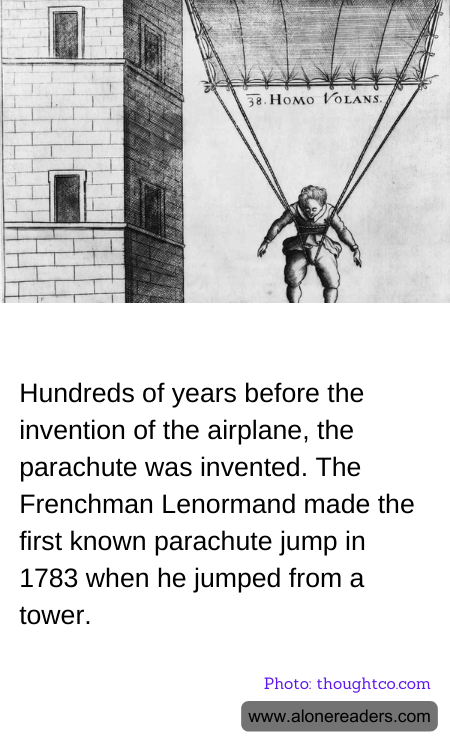
The concept of the parachute, fascinatingly, predates the airplane by centuries, illustrating an early human fascination with mastering the art of landing safely from heights. The idea of the parachute was first conceived by the innovative minds of the Renaissance, particularly by the legendary artist and inventor Leonardo da Vinci in the late 1400s. His sketches of a pyramid-shaped canopy resembling a parachute are among the earliest recorded designs, although there's no evidence that da Vinci’s design was ever tested during his lifetime.
It wasn’t until the late 18th century that the practical application of the parachute was demonstrated. The honor of making the first known parachute jump goes to Louis-Sébastien Lenormand of France. In an audacious public display in 1783, Lenormand jumped from the tower of the Montpellier observatory using a 14-foot parachute, intriguing the gathered crowd. This marked the first documented instance of someone using a parachute to safely descend from a height, and Lenormand coined the term 'parachute' by combining the French word ‘para’, meaning 'protect against', and ‘chute’, the French word for 'fall'.
Lenormand's pioneering jump spurred further interest and developments in the field of parachutes. Throughout the 19th century, improvements were made, notably by pioneers like Joseph and Jacques Montgolfier, who also invented the hot air balloon. They experimented with deploying parachutes from balloons, essentially creating the first model of the modern parachute jump.
In the 20th century, the parachute evolved significantly, particularly with enhancements in materials and design. Parachutes were extensively used in both World Wars for military purposes, including by airborne forces and pilots. These applications demonstrated the parachute's value as a lifesaving tool, beyond the realms of adventure and spectacle.
Today, parachuting is a well-established sport and recreational activity, as well as a critical part of safety procedures in aviation and space travel. Modern parachute designs incorporate advanced technology to ensure safety, performance, and precision. This evolution from a daring stunt to a sophisticated aerospace component is a remarkable journey that reflects ongoing human ingenuity and our innate desire to conquer the skies. With the integration of new materials and technologies, like GPS and automated deployment systems, parachutes will continue to evolve, providing safer and more thrilling experiences for users around the globe.
