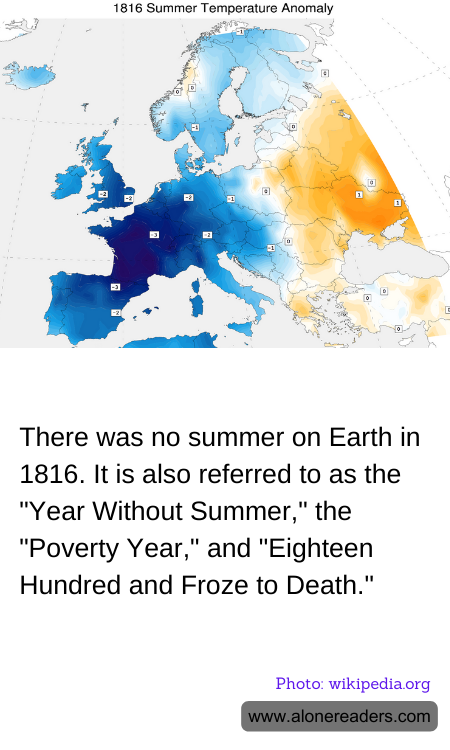
In 1816, the world experienced a unique meteorological phenomenon known as the "Year Without Summer," also ominously dubbed the "Poverty Year" and "Eighteen Hundred and Froze to Death." This year is historic for its severe climate abnormalities that resulted in average global temperatures dropping by as much as 0.4–0.7 °C. This led to major food shortages across the Northern Hemisphere.
The cause of this dramatic cooling was the April 1815 eruption of Mount Tambora in Indonesia, the most powerful volcanic eruption in recorded history. Its massive ash cloud was propelled high into the stratosphere, reducing sunlight and significantly altering atmospheric circulation patterns. The eruption expelled vast quantities of volcanic ash and sulfur dioxide into the atmosphere, which formed a "volcanic winter," spreading fine ash and gases globally, dimming sunlight, and disrupting weather patterns.
Notably, the Northeast United States, Atlantic Canada, and parts of Western Europe experienced extraordinary climatic anomalies. Summer temperatures in these regions plummeted, leading to frequent frosts and snowfalls. In May 1816, frost killed off most crops in New England, and in June, two large snowstorms in eastern Canada buried crops under a thick blanket of snow. The chill continued through July and August, with reports of frozen rivers and lakes in Pennsylvania in July.
Europe faced dire straits as well. The persistent cold and torrential rains triggered severe crop failures, exacerbating the food shortages caused by years of war and economic hardship from the Napoleonic Wars. The situation was dire enough to cause mass migrations of European populations and instigate widespread social unrest.
The year 1816 also saw cultural impacts, particularly in literature and art. The dreary summer forced Mary Shelley, Percy Bysshe Shelley, Lord Byron, and John Polidori to stay indoors during their holiday at Lake Geneva, leading to the creation of iconic works like Mary Shelley’s "Frankenstein" and Polidori’s "The Vampyre."
The ecological and societal impacts of the "Year Without Summer" had a lasting effect on the 19th-century world, contributing to significant demographic shifts, changes in agricultural practices, and influence on art and literature, reflecting how a single volcanic event can trigger global changes. The events of 1810s help underscore the delicate balance of our climate system and remain a stark reminder of nature’s unpredictable power.
