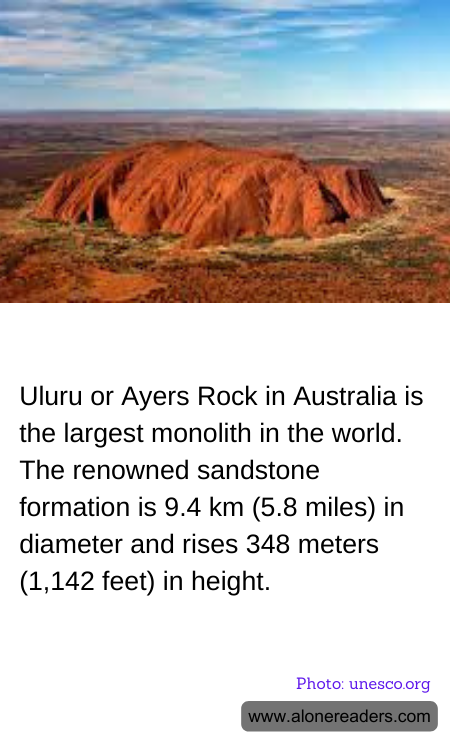
Uluru, also known as Ayers Rock, is a massive sandstone monolith in the heart of the Northern Territory’s arid "Red Centre" in Australia. It is not only a spectacular natural formation but also a deeply sacred site for the Anangu, the traditional Aboriginal landowners. The rock itself stands about 348 meters (1,142 feet) high and has a total circumference of 9.4 kilometers (5.8 miles), making it the world's largest monolith.
For the Anangu, Uluru is imbued with spiritual significance, featuring prominently in their cultural traditions and stories. The rock is dotted with various caves, carvings, and paintings that are integral to their spiritual lore. Recognizing its cultural importance, the site was handed back to the Anangu people in 1985, under the condition that it would be leased back to Parks Australia for 99 years, to be jointly managed as a national park.
The formation itself is about 600 million years old. It was formed by the slow deposition of sand in an ancient sea, followed by the uplifting and folding of the sediment. The remarkable red hue of Uluru is due to the oxidation of its iron-bearing minerals when exposed to the air, a process similar to the rusting of iron.
Despite its remote location, Uluru attracts tourists from around the world, drawn by its natural beauty and cultural significance. However, tourism has been a double-edged sword. While it has brought economic benefits, it has also posed challenges, especially in terms of environmental impact and cultural disrespect. In response to the wishes of the traditional owners and to preserve the sanctity of the site, climbing on Uluru was permanently banned in October 2019.
The allure of Uluru extends beyond its physical appearance. Sunrises and sunsets transform the rock’s appearance, with its colors shifting from fiery red to soft purple, making these times particularly magical for visitors. This visual spectacle, coupled with its cultural resonance, continues to make Uluru a revered and iconic landmark, not just within Australia but globally.
