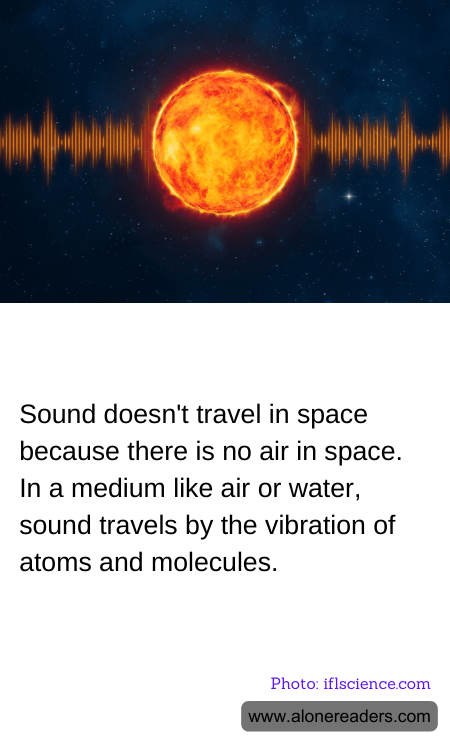
Sound, as we experience it on Earth, requires a medium through which to travel. This medium can be solid, liquid, or gas, and it is the vibrations of the molecules in these mediums that carry sound waves from one point to another. However, space presents a unique environment where traditional sound transmission is impossible due to its lack of atmosphere.
In space, the absence of any atmospheric gases means there are no molecules or atoms close enough to each other to facilitate the propagation of sound waves. Space is not a complete vacuum but it is close enough that the particles are too sparse and too far apart to transmit sound. This is why astronauts cannot hear noises in space—as there is no air or other medium to carry sound waves to their ears.
In contrast, here on Earth, when a sound is made, it causes vibrations in air molecules. These molecules bump into their neighboring molecules, and this chain reaction continues until the sound wave reaches our ears. For example, when someone speaks, vibration of their vocal cords pushes air molecules into motion, creating sound waves that we interpret as voice. Similarly, in water, sound travels much faster because the molecules are closer together compared with air, providing a more efficient path for the transmission of sound waves.
Understanding this fundamental difference in sound transmission highlights not only the uniqueness of Earth's atmosphere but also the challenges of communication in space. This is why astronauts use radios to communicate while on spacewalks or on the surface of other planets. These devices convert sound into radio waves, which can travel through the vacuum of space, allowing for the transmission of audio information despite the absence of a traditional sound-transmitting medium.
The silence of space thus deepens our appreciation for the complex and life-sustaining nature of our own planet, and it emphasizes the profound isolation of the cosmos. The fact that sound cannot travel through space only underlines the vastness and the desolation that exists beyond the thin blue line of our atmosphere.
