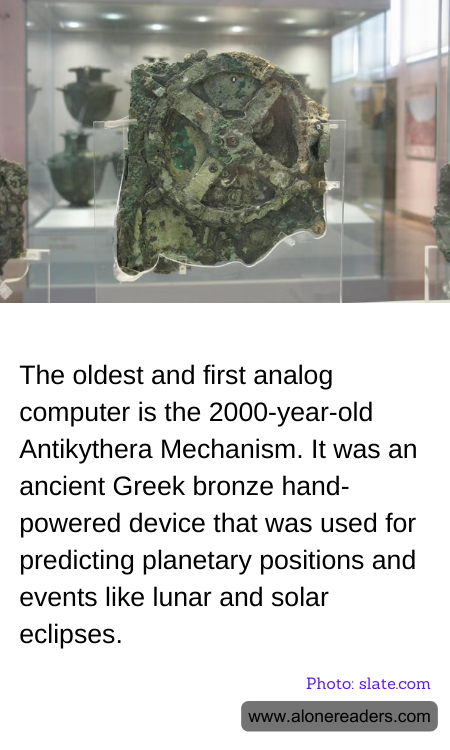
The Antikythera Mechanism, a remarkable ancient Greek artifact, is considered the world's oldest known analog computer. Believed to have been constructed around the 2nd century BCE, this sophisticated device was used to predict astronomical positions and eclipses for calendrical and astrological purposes. Discovered in 1901 amid a shipwreck near the Greek island of Antikythera, the mechanism's complexity and workmanship are reminiscent of a 19th-century Swiss clock.
Constructed mainly from bronze, the mechanism is a testament to the advanced engineering skills of the ancient Greeks. It consists of at least 30 meshing bronze gears set in a case made of wood and bronze. Researchers believe these gears were used to drive pointers on the front and back dials, tracking celestial time and the positions of the sun, moon, and possibly the planets known at the time.
The front dial likely displayed the zodiac and calendar, using a fixed ring on the outside while the gears moved the pointers to show the date and positions of celestial bodies. The larger rear dial was used to predict eclipses and record lunar cycles. Interestingly, it even accounted for the irregular orbit of the moon—what is known today as the first lunar anomaly—using a sophisticated differential gear arrangement.
The precision and foresight behind the Antikythera Mechanism highlight not only the technological ingenuity of the ancient Greeks but also their desire to merge practical engineering with their quest for knowledge about the cosmos. The device essentially allowed its users to predict celestial events several decades in advance, which would have been of immense utility, not only for navigation and agriculture but likely also for ceremonial purposes.
Despite its antiquity, it took until recent decades for the importance and complexity of the Antikythera Mechanism to be fully appreciated, largely due to the intricacies involved in its study and restoration. Today, it stands as a profound testimony to the scientific acumen of ancient civilizations, and continues to fascinate scientists, historians, and technology enthusiasts around the world. The mechanism not only predates similar technological advances by centuries, but it also challenges our understanding of technological development in ancient times, showing that ancient inventors could create a tool of astonishing mechanical sophistication long before the advent of similar tools in more modern times.
