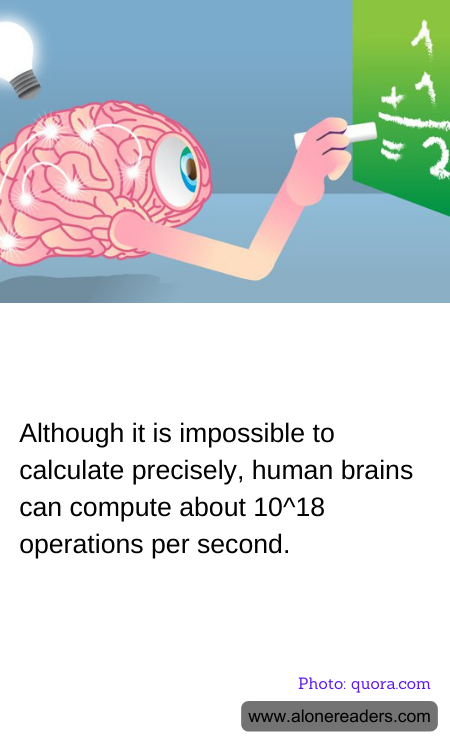
The human brain is an incredibly sophisticated organ, often compared to the complexity and functionality of modern supercomputers. While quantifying the full computational power of the human brain in exact terms is a challenging endeavor, estimates suggest that the human brain can perform around 10^18 operations per second. This staggering number helps illustrate just how potent and efficient the brain is at processing and analyzing information.
The comparison between the human brain and a computer is based primarily on the brain's ability to perform parallel processing at a scale that far exceeds what contemporary technology can achieve. The brain comprises approximately 86 billion neurons, each capable of independently processing information. Neurons communicate through synapses, and with over 100 trillion synapses facilitating the connections, the brain's network complexity allows for an immense processing capacity across various types of information simultaneously.
This parallel processing capability enables humans to perform incredibly complex tasks, such as learning languages, recognizing faces, and adapting to new situations, with remarkable efficiency and speed. Furthermore, unlike computers that require explicit programming, the human brain is capable of learning and adapting through experience and sensory input, showcasing an advanced form of computational flexibility.
Moreover, the brain's energy efficiency is another aspect where it vastly outperforms even the most advanced computers. The brain operates on roughly 20 watts of power, a fraction of the energy used by modern supercomputers which can require as much as tens of thousands of watts. This efficiency does not only represent a technological marvel but also poses a significant challenge for scientists and engineers attempting to design artificial systems that can match the capabilities of the human brain.
In attempting to emulate the computational abilities of the brain, fields such as artificial intelligence and neural networks have made significant strides. However, they still face immense challenges in mimicking the depth of neural activity and the subtleties of brain functions. The endeavor not only helps improve technological tools and interfaces but also enables a deeper understanding of the biological processes of the human brain itself.
In conclusion, while the estimate of the brain performing 10^18 operations per second simplifies the complexity of its capacities, it serves as a useful measure to appreciate the extraordinary capabilities of the human brain. As research continues to advance, further insights into the brain’s mechanisms will undoubtedly enhance both scientific knowledge and technological innovation.
