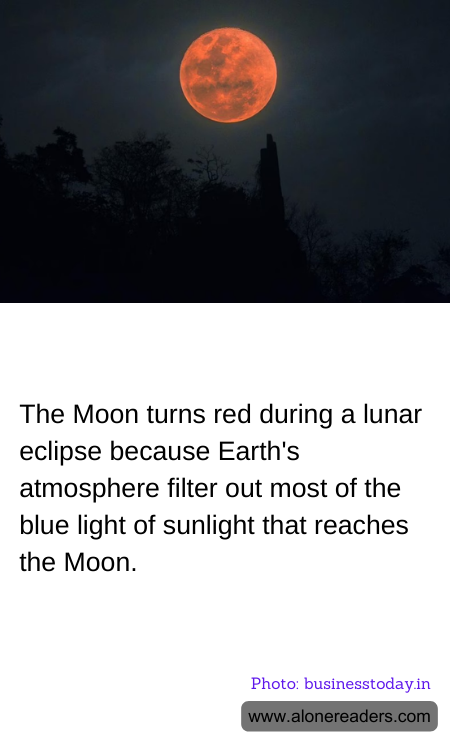
When a lunar eclipse occurs, the Moon can take on a striking red hue, a phenomenon often referred to as a "Blood Moon." This dramatic transformation is the result of a specific alignment of the Earth, Moon, and Sun. During a lunar eclipse, the Earth is positioned directly between the Sun and the Moon, casting a shadow across the lunar surface.
The reason the Moon turns red, rather than simply darkening, has to do with the way Earth's atmosphere interacts with sunlight. As sunlight passes through the Earth's atmosphere, the shorter blue wavelengths of light are scattered by the air molecules, a process known as Rayleigh scattering, which is also responsible for the blue color of the sky. What passes through the atmosphere after this scattering is primarily the longer wavelengths of light, which are in the red part of the spectrum.
This filtered sunlight, now predominantly red, bends towards the Moon due to the Earth's atmospheric refraction. Essentially, Earth's atmosphere acts like a giant lens, refracting the red sunlight and focusing it onto the Moon during an eclipse. As a result, even though the Moon is in the Earth's shadow, it receives this bent red light, illuminating it with a coppery glow.
The exact appearance of the Moon during a lunar eclipse can vary from one event to another. Factors such as atmospheric conditions, the amount of particulate matter in the air, and the path of the sunlight through the Earth's atmosphere can all influence the intensity and hue of the red color. For instance, a higher concentration of dust or volcanic ash in the Earth's atmosphere can lead to deeper or more vivid shades of red.
Thus, the eerie yet beautiful sight of the red Moon during a lunar eclipse is a direct result of Earthly atmospheric conditions. This cosmic display not only provides a spectacular visual experience but also illustrates the complex interplay of light, matter, and celestial mechanics within our solar system.
