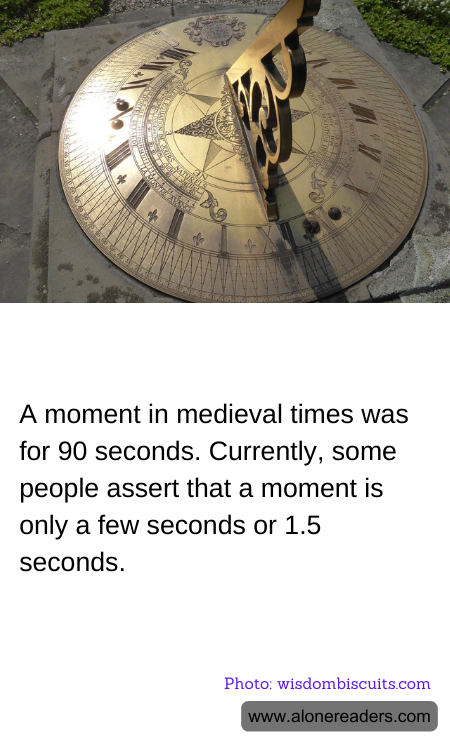
In medieval times, the concept of measuring time was markedly different from today's standards, incorporating a system that might seem unfamiliar to us now. A "moment" in the medieval period was specifically defined as 90 seconds. This division of time was based on the system used by medieval monks, among others, to structure their daily routines, prayers, and duties. This system was not only applied religiously but also influenced the broader societal understanding of time during that era.
The transformation of the term "moment" over centuries showcases the evolution of time measurement according to technological advances and changes in societal needs. Today, the term "moment" does not have a precise definition in the context of time and is often used more colloquially to imply a very short period. Typically, it is understood to last only a few seconds, sometimes estimated as approximately 1.5 seconds in casual conversation or in common sayings. This reflects today's pace of life and the ways in which modern society perceives and values time—short, quick, and fleeting.
The adaptation from a strictly quantified 90-second duration to a more imprecise and fleeting concept highlights changing perceptions of time due to technological advancements in timekeeping and the overall acceleration of daily life. In the Medieval period, the measurement tools available were rudimentary like sundials or the canonical hours used by clergy, which were more focused on practicality for daily schedules rather than precision. In contrast, modern society, with its atomic clocks and digital timekeepers, emphasizes accuracy and precision, effectively shrinking our perception of what constitutes a moment.
Therefore, while the definition of a moment has undoubtedly contracted in terms of its duration, its use has broadened, encapsulating the essence of our current interaction with time—an immediate, almost instantaneous, span. This change not only encapsulates the technological advancement but also our cultural adaptation to a faster-paced world. Understanding this shift allows us to appreciate the fluid nature of time measurement and the ways it continues to shape our interaction with the world around us.
