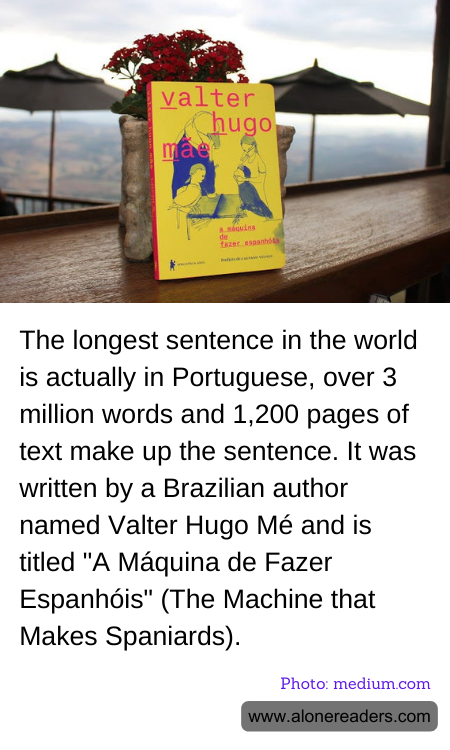
The longest sentence in the world, an extraordinary literary achievement, is credited to Valter Hugo Mãe, a prolific Portuguese author. His novel, "A Máquina de Fazer Espanhóis" (The Machine that Makes Spaniards), contains a gargantuan sentence that spans across its pages, making it a unique piece of literature recognized globally for its length and complexity. This particular sentence stretches over 3 million words and covers 1,200 pages, representing a significant portion of the novel. Written in Portuguese, Mãe’s work not only pushes the boundaries of conventional narrative structures but also challenges the reader’s engagement and perception of language and flow in literature.
Mãe, renowned for his experimental style, integrates this extensive sentence seamlessly into the broader context of the book, which generally revolves around the themes of old age, identity, and memory. The novel tells the story of an elderly man who, after the death of his wife, is moved to a nursing home and is forced to reevaluate his life and his understanding of his homeland. The sprawling sentence that Mãe employs is not just a gimmick but serves to mirror the protagonist's stream of consciousness and the continuity of life’s experiences.
The implications of using such a long sentence extend beyond the sheer novelty. It challenges traditional narrative forms and invites discussions about the limitations and possibilities of written language. Furthermore, it emphasizes the flow of thought and the unbroken stream of consciousness that often characterizes human thinking patterns. This literary technique has been interpreted as an attempt to encapsulate the unending, intertwined thoughts and memories that define a person’s essence.
Valter Hugo Mãe's record-setting sentence has not only set a benchmark in the literary world but has also inspired a discourse on the flexibility of the novelistic form and the expressive capabilities of the Portuguese language. His work is a testament to the enduring power of literature to innovate and provoke thought, proving that even in the modern age, there are still new thresholds to explore in the art of storytelling. Through "A Máquina de Fazer Espanhóis," Mãe has contributed significantly to the literary heritage and continues to influence writers and readers alike with his bold narrative choices.
