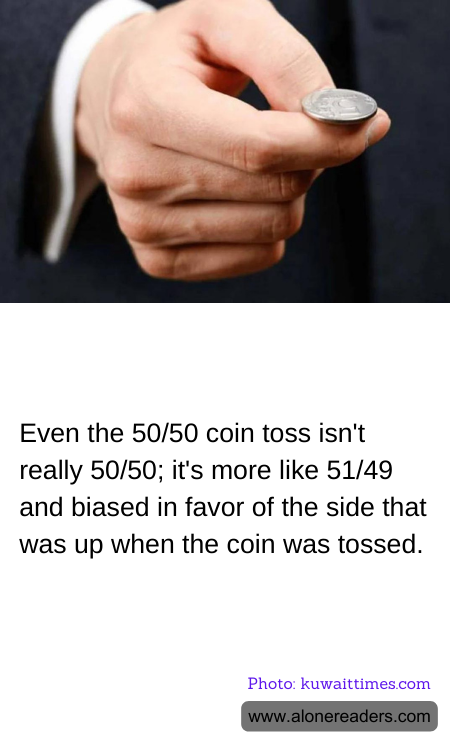
The notion of a coin toss being a perfectly balanced event is widely accepted. It seems the epitome of randomness, used to determine outcomes in sports events, settle disputes, or make decisions. However, interestingly, a coin toss is not as fair as it might appear. Research and experimental data suggest that there is in fact a slight bias depending on which side is facing up when the coin is flipped. Typically, we might expect a 50/50 outcome, but it's closer to 51/49.
This slight deviation from expectation can be attributed to a number of physical and environmental factors. For example, the dynamics of how a coin is flipped such as the height from which it is tossed, the force applied, and the air resistance, all can subtly influence the outcome. What is particularly intriguing is the bias shown towards the side that was originally facing up when the coin is tossed. If, for instance, heads is facing up when the coin is flipped, there's a marginally greater chance that the coin will land heads up.
The bias is not large, but it is statistically significant, challenging the notion of the coin toss as a tool for making perfectly fair decisions. Mathematicians and statisticians have delved deep into the physics of flipping, revealing that factors such as the uneven distribution of mass within the coin and the way it is caught or allowed to land can impact this perceived randomness.
Furthermore, a study by Stanford and UC Santa Cruz found that using a vigorous flipping motion where the coin spins many times can help counteract some of these biases, making the toss more even. Nevertheless, while the coin is flipping, the side facing up at the beginning is slightly more likely to end up on top when the coin stops moving.
Although the difference is slight, the implications are profound, particularly in situations where major decisions are based on the outcome of a coin toss. In professional sports, for example, the kickoff or the initial play can be determined by this method, potentially giving one team a minuscule edge over another due to this bias. These findings illuminate an often overlooked aspect of probability and highlight that even the simplest systems can have underlying complexities. Whether for resolving playground disputes or initiating major sports events, it serves as a reminder that true randomness is hard to achieve, even in seemingly straightforward scenarios.
