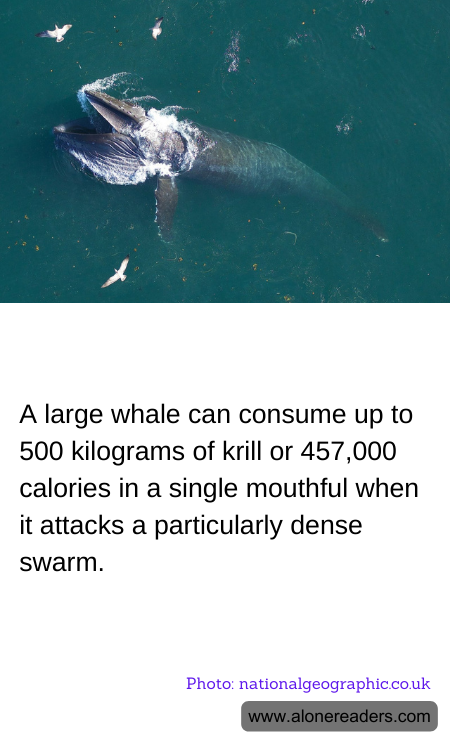
In the vast oceanic expanses, large whales engage in feeding behaviors that are as colossal as their size. One of the most awe-inspiring feats is their ability to consume up to 500 kilograms of krill in a single mouthful. This massive intake amounts to roughly 457,000 calories, showcasing the immense energy requirements needed to sustain these gigantic marine mammals.
Whales typically feed on krill by using a method known as filter feeding. They take in huge quantities of water rich with krill, and then, using their baleen plates, they filter out the water and retain the krill. This process is highly efficient, allowing whales to thrive in ocean environments where krill are found in dense swarms. The sheer volume of krill consumed not only underscores the biological efficiency of these marine giants but also their role in the ocean's ecosystem as major consumers of krill.
Krill, small crustaceans resembling tiny shrimp, are a critical part of the marine food chain. They feed on phytoplankton and, in turn, are the primary food source for many marine animals, including whales. The health and stability of krill populations are therefore vital not just for the survival of individual whales but for the overall balance of marine life.
The feeding behavior of whales has significant ecological implications. By consuming vast amounts of krill, whales help regulate the populations of these small creatures, thus maintaining a balance in the nutrient cycle of the ocean. Furthermore, this feeding strategy highlights the interdependence of species within marine ecosystems and underscores the importance of conserving such environments.
The capacity of large whales to ingest such enormous quantities of food in a single gulp is a marvel of nature, demonstrating not only the adaptability and power of these creatures but also the intricate design of oceanic life. Understanding these dynamics is essential for protecting these majestic animals and the oceans that sustain them, ensuring that they continue to thrive for generations to come.
