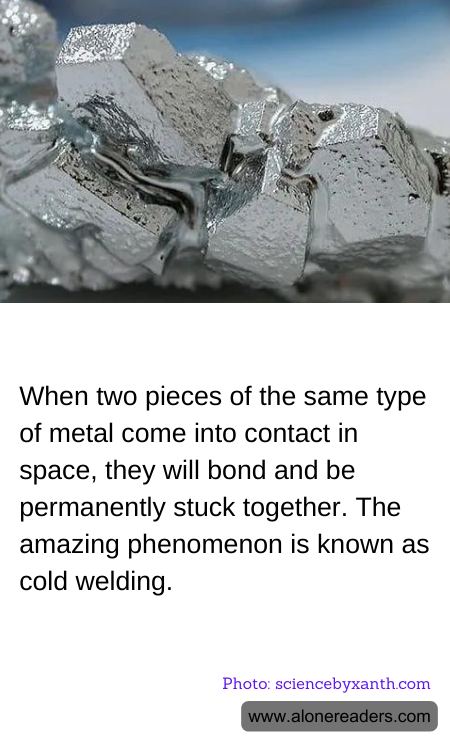
In the vast, silent expanse of space, a fascinating phenomenon occurs when two pieces of the same metal touch: they can bond irrevocably in a process known as cold welding. This intriguing natural occurrence deviates from typical earthly experiences with metal, where air and moisture create a thin layer of oxidation that prevents such bonding. However, in the vacuum of space, where there is no air or moisture to form this protective oxide layer, metal surfaces exposed to this environment maintain their pristine condition.
When these clean, exposed metal surfaces in space come into contact, they bond at an atomic level, essentially becoming a single piece. This is because, in the absence of an intervening substance, the atoms of one piece of metal do not "know" that they are different from the atoms of the other piece, allowing them to fuse together. This is possible due mainly to the free-moving electrons in the outer atomic layers, which freely interact and create a bond.
Cold welding was first observed in the early 20th century but gained significant attention during the space race when the phenomenon posed both a challenge and a unique opportunity for constructing and repairing objects in outer space. Originally, this process could unintentionally lead to spacecraft components sticking together without the application of heat or additional adhesives. However, understanding and controlling this process can be advantageously utilized in space manufacturing and repairs, reducing the reliance on traditional welding equipments that are typically less feasible in a zero-gravity environment.
The realization and management of cold welding have important implications for future space missions, including the construction of large-scale space structures and the potential for in-space manufacturing of complex components, which might be too large or impractical to launch from Earth. Engineers continue to explore the boundaries and applications of cold alloweding in modern space technology, ensuring that structures can withstand the rigors of space travel and the harsh conditions encountered beyond Earth's atmosphere. As explorations and prolonged space endeavors increase, the ability to manipulate and harness phenomena like cold welding becomes crucial for the advancement of aerospace technology and construction beyond our world.
