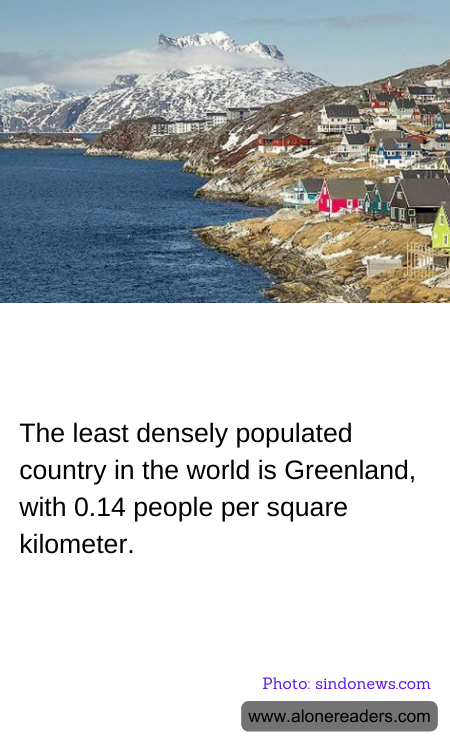
Greenland holds the distinction of being the least densely populated country in the world, a fact that adds to its mystique and allure. With only 0.14 people per square kilometer, this vast land offers expansive arctic landscapes mostly untouched by human activity. Greenland's sparse population can be attributed to its harsh climate and challenging living conditions. Most of the island is covered with ice, with the ice cap taking up about 80% of its surface area, making large regions uninhabitable.
The majority of Greenland's small population, which totals around 56,000 people, lives in the coastal regions, where the climate is milder and access to resources such as the ocean is direct. These communities are often isolated from each other, with travel between them typically reliant on boats, helicopters, or planes, as there are no connecting roads over the ice cap.
Despite its low population density, Greenland has a rich history populated by resilient and adaptable communities. The indigenous Greenlandic Inuit have inhabited the island for thousands of years, developing unique knowledge to survive its extreme conditions. Today, that cultural legacy continues to influence Greenlandic society, manifesting in language, art, and traditional practices such as dog sledding and subsistence hunting, which are vital both for community sustenance and cultural continuity.
Greenland's environment is a paradox of extreme conditions and delicate ecosystems, which face threats from climate change. The warming climate is causing Greenland’s massive ice sheets to melt at an accelerated rate, which not only impacts local wildlife and communities but has global implications as well, especially in terms of rising sea levels. These environmental changes are of international concern and are closely monitored by scientists and environmentalists worldwide.
In conclusion, while Greenland may be the least densely populated country globally, its significance—both environmentally and culturally—is substantial. This vast land of ice and snow is a crucial region for researchers studying climate change and a unique reservoir of biodiversity and indigenous culture. As the world becomes increasingly interconnected, Greenland's strategic importance and global environmental impact continue to grow, making it an essential player in conversations about ecological preservation and sustainable living.
