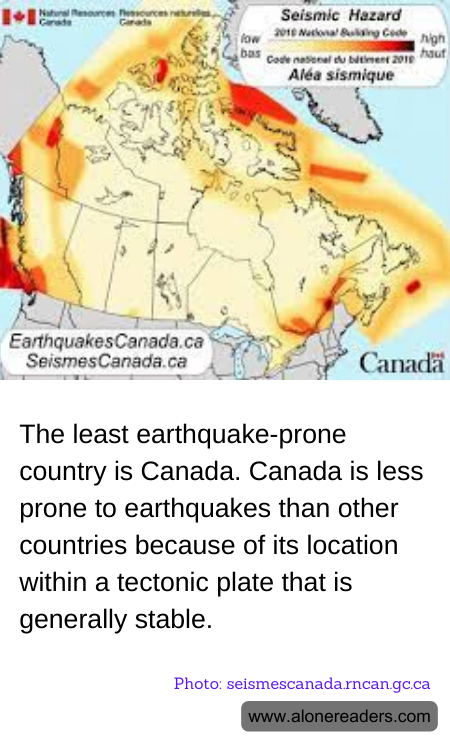
Canada is often perceived as a country with minimal seismic activity, largely due to its geographic positioning on the stable interior of the North American Plate. Unlike regions along tectonic plate boundaries, such as the Pacific Ring of Fire, where seismic activity is frequent and intense, most of Canada experiences far fewer and less severe earthquakes. However, it is important to clarify that while Canada may be less affected than nations like Japan, Indonesia, or Chile, it is not correct to label it as the least earthquake-prone country globally.
Significant parts of Canada, particularly along the western coast of British Columbia, are close to the Cascadia Subduction Zone, an area capable of producing very powerful earthquakes. Historical records and geological evidence indicate that this region has experienced megathrust earthquakes, which are among the world's most powerful, with magnitudes that can exceed 9.0. For example, the 1700 Cascadia earthquake had profound effects on coastal areas and was accompanied by a massive tsunami.
Elsewhere in Canada, other regions like the St. Lawrence River valley in Quebec and parts of the Yukon are also susceptible to seismic events, though generally with lower frequency and intensity compared to the western regions. Despite this, the majority of Canada's extensive landmass lies in areas considered seismically stable, not prone to the intense seismic activity found in more vulnerable parts of the world.
Canadian authorities, recognizing the potential risks in certain areas, have taken significant steps to mitigate the impact of possible seismic events, particularly in British Columbia. Building codes and urban planning guidelines have been adapted to account for earthquake risks, focusing on improving the resilience of new structures and critical infrastructure.
In summary, while Canada is one of the safer countries in terms of seismic activity, especially when compared to those located on or near sensitive tectonic boundaries, it is not entirely free from earthquake risks. Understanding the regional variations in seismic activity within Canada is crucial for disaster preparedness and urban planning.
