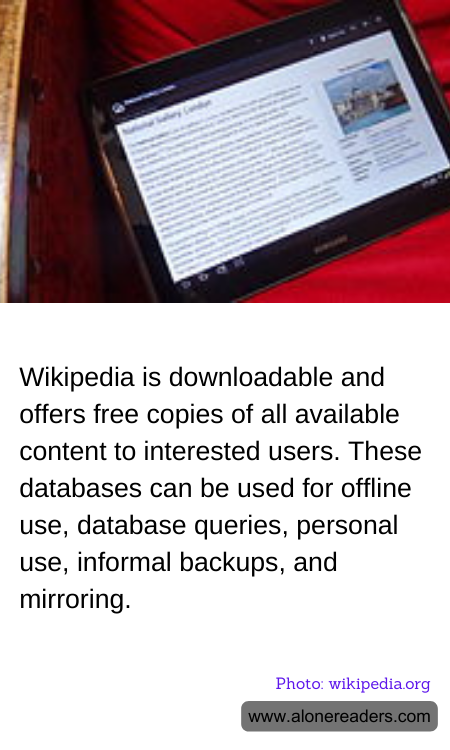
Wikipedia, the extensive online encyclopedia that anyone can edit, offers a unique feature that dramatically enhances its utility beyond online access: its entire database is available for download. This enables users not only to view Wikipedia's expansive library of content offline but also to perform complex database queries, use the data for personal projects, create informal backups, or even set up mirrors of its content.
This downloadable feature of Wikipedia is pivotal for numerous reasons. In areas where internet connectivity is unreliable or expensive, having offline access to Wikipedia can provide crucial educational resources. Educators and students in remote or under-resourced locations can continue to access vast amounts of information, ranging from historical facts to scientific knowledge, which can be extremely valuable in educational settings.
Beyond educational use, the ability to download Wikipedia’s database allows tech enthusiasts and researchers to engage with its content more deeply. For instance, data scientists and software developers can use the comprehensive dataset for training machine learning models, analyzing patterns, or creating applications that make educational content more accessible and engaging.
Moreover, the provision to create informal backups safeguards the accessibility of knowledge under circumstances where the original online version might be compromised or unavailable. Likewise, by setting up mirroring sites, individuals and organizations can contribute to the global availability and redundancy of free knowledge. This is particularly important to ensure the persistence and unobstructed availability of information in the face of censorship or digital restrictions imposed by authoritarian regimes.
However, there are challenges and important considerations to keep in mind. The size of the complete Wikipedia database is considerable, and downloading it requires adequate storage capacity and a robust network connection. Additionally, users who download and use Wikipedia’s content must ensure compliance with its licensing terms, primarily the Creative Commons Attribution-Share-Alike license, which requires proper attribution and sharing of any derivative works under the same license.
In conclusion, the availability of Wikipedia for download is a significant extension of its mission to disseminate free knowledge to the world. It supports educational initiatives, fosters innovation in data usage, provides a backup in the event of internet censorship, and facilitates the global exchange of information. As technology advances and the digital divide narrows, the impact of such features is likely to increase, making knowledge more accessible and empowering more people around the world.
