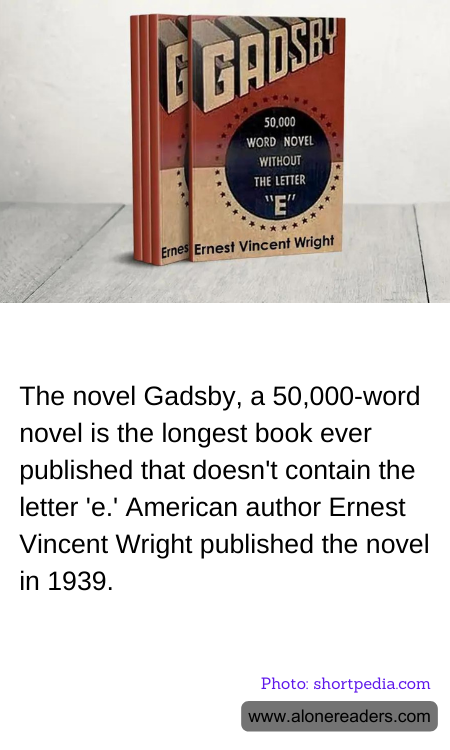
Gadsby is an extraordinary novel for its constraint on the use of the English language, specifically omitting the letter 'e,' which is the most common letter in the alphabet. Written by Ernest Vincent Wright and published in 1939, this ambitious literary work stretches across 50,000 words. The novel falls under the category of a lipogram, a kind of written work that avoids using one or more letters of the alphabet. Wright's choice to exclude 'e' is particularly challenging given its frequent use in the English language, making Gadsby a pioneering example of constrained writing.
The storyline of Gadsby revolves around the fictional city of Branton Hills, which is rejuvenated under the leadership of the protagonist, John Gadsby. Through the narrative, Wright explores various facets of urban growth and development, community leadership, and the power of youth to make a difference, all woven into a rich tapestry of characters and events that propel the town's transformation. The absence of the letter 'e' forced Wright to delve into the depths of English vocabulary, finding creative replacements and restructuring sentences to maintain a coherent and engaging narrative.
The writing of Gadsby was no small feat. Wright himself noted the significant challenges he faced during its creation, documenting his experiences and the methods he used to avoid the barred letter in the book’s introduction. He famously tied down the 'e' key on his typewriter to avoid using it by mistake, illustrating the level of commitment required to achieve such a task. Wright hoped that his efforts in writing Gadsby would demonstrate the vast possibilities of the English language and inspire others to experiment with their own styles of creative writing.
Despite its initial obscurity, Gadsby has gained a cult following over the years among fans of unique and ambitious literature. Tracking down a copy can be challenging as the original print run was small, and the novel was not widely distributed. However, its reputation has grown, supported by an intrigued literary community that values the novel’s unique constraint and the determination shown by Wright in the face of such a linguistic challenge.
Overall, Gadsatto remains a testament to creative ambition and showcases the endless possibilities of literary expression. It serves not only as a curiosity but also as an inspiration for writers and creatives, proving that sometimes the greatest innovations arise from the most challenging restrictions.
