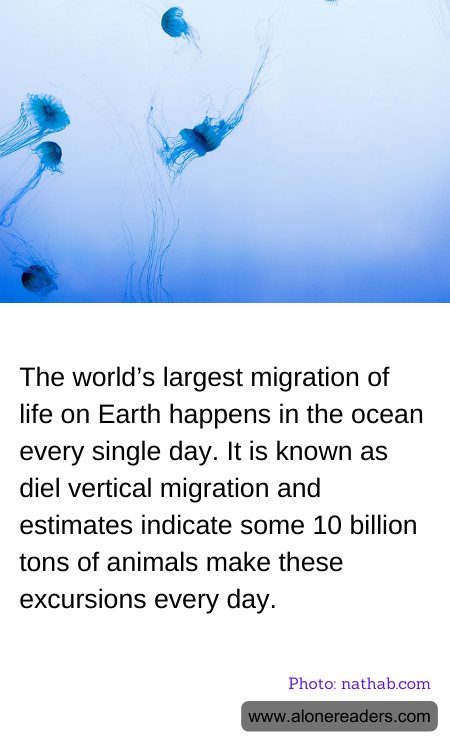
The world’s oceans are home to an incredible phenomenon known as diel vertical migration, a daily movement by countless marine creatures, which is considered the largest migration on the planet in terms of biomass. This mesmerizing natural occurrence involves an estimated 10 billion tons of marine life, including fish, squid, krill, and jellyfish, which undertake a vertical trek through the water column.
Diel vertical migration primarily occurs at dusk when many sea creatures rise from the depths of the ocean toward the surface. This migration is largely driven by the need to feed on plankton that accumulates near the ocean’s surface where sunlight fuels the growth of these tiny organisms. As night falls, the plankton thrives, drawing a diverse array of marine life upwards in pursuit of food in a relatively safer, dark environment, where they are less visible to predators.
As dawn approaches, the scenario reverses; the same marine organisms dive back down to the darkness of deeper waters. This return to the depth serves multiple purposes. It helps them avoid predators that hunt by sight in the daylight, and it also conserves water in their bodies by moving to colder, deeper layers during the day. The tremendous scale of this daily migration is not only a spectacle but also plays a critical role in the ocean ecosystems, including nutrient cycling. The vertical movement helps in mixing the different layers of the ocean, distributing nutrients and oxygen throughout the depths, which supports diverse life forms in various ocean habitats.
This massive daily migration impacts not only the ecology of the oceans but also the global climate. By moving in such large numbers, these animals contribute to the oceanic carbon cycle. During the day, carbon dioxide absorbed by sea water is consumed by photosynthetic plankton near the surface. When these plankton are eaten by migrating animals, which subsequently return to the depths, they help in transporting carbon away from the atmosphere and storing it in the deep ocean.
Understanding diel vertical migration aids scientists in better grasp the complexities of marine ecosystems and the impacts of climate change on the ocean. Moreover, it highlights the interconnectedness of ocean health to the overall health of our planet, underscoring the need to conserve these critical marine environments against the burgeoning threats of overfishing, pollution, and global warming. Thus, while it might be less visible than the great migrations seen on land, the diel vertical migration is no less vital to the ecological and climatic stability of our planet.
